
Upcoming Events
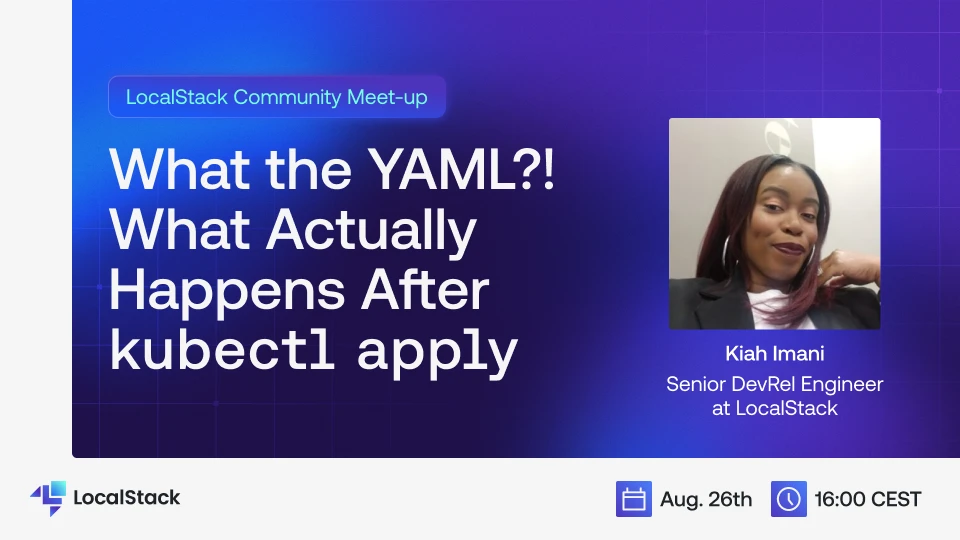
Developers are used to running kubectl apply and waiting on the magic to happen resulting in a running Kubernetes pod. But what actually happens between entering the command and the deployment being ready? What's the reality behind the "magic"? In this talk, Kiah will dissect all the stages of a Kubernetes deployment in a way that is easy to understand. She'll walk through that deployment happening locally on LocalStack to inspect what's really going on at each stage. At the end of this session, attendees will have a deeper understanding of the Kubernetes deployment process that can help debug many common issues and will gain an understanding of how LocalStack enables local testing of Kubernetes.
Have a talk idea?
Do you want to present at our events? We are not just limited to LocalStack—Talks around AWS, Developer Productivity, Cloud Security, DevOps toolings, Development & Testing loops, Snowflake and more would add great value to our members. Fill out the form to propose your talk at one of our Community Events
Previous Talks
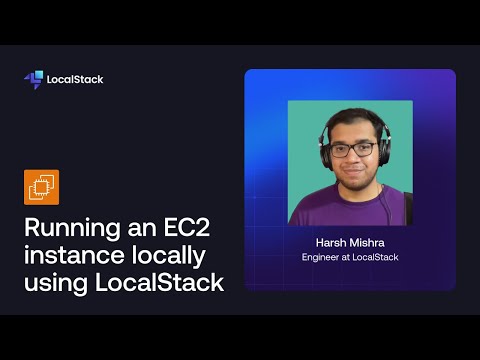
In this video, you'll learn how you can run an Elastic Compute Cloud (EC2) instance locally using LocalStack's core cloud emulator. Elastic Compute Cloud (EC2) is a core service within Amazon Web Services (AWS) that provides scalable and flexible virtual computing resources. EC2 enables users to launch and manage virtual servers, commonly referred to as instances. LocalStack is a core cloud emulator that allows you run EC2 instances using a Docker backend. Under the hood, LocalStack spins another Docker container that mimics an EC2 instance functionality, including other add-on features such as EBS, IMDS, and Load Balancers. Corrections: LocalStack will no longer provide the Ubuntu 20.04 Docker AMI (used in this video) by default in the next major release, though it can still be manually added, and on nine minutes & nine seconds mark, we meant 'localhost' instead of 'localstack'. To access the web server, you can hit the localhost:8000 endpoint as shown in the video.
Get started with LocalStack in minutes! In this episode, we’ll clone a ready-to-go AWS sample app, spin up LocalStack, and run everything locally without a cloud account. By the end, you’ll have a fully functional event-driven app running on your machine.
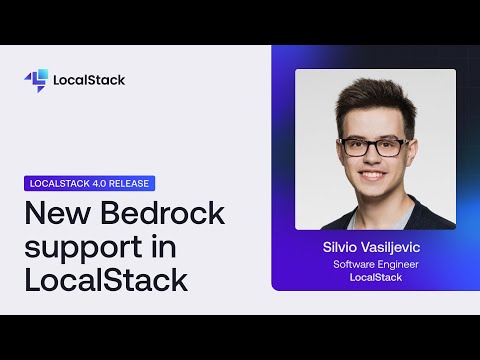
Bedrock is a fully managed service provided by Amazon Web Services (AWS) that makes foundation models from various LLM providers accessible via an API. LocalStack allows you to use the Bedrock APIs to test and develop AI-powered applications in your local environment. In this video, Silvio showcases how LocalStack 4.0, with our new Bedrock support, is keeping up with advancements in Generative AI (GenAI) and large language Model (LLM) ecosystems. You'll learn what Amazon Bedrock is, the benefits of Bedrock emulation, and a live demo of how it works.
LocalStack's core cloud emulator lets you emulate various cloud services on your own computer. This means you can develop and test your cloud-based solutions without connecting to a remote cloud. However, there are times when you need to seamlessly switch between your local setup and actual cloud resources, especially in hybrid situations. For instance, you might want to share a database with your local Lambda function or access S3 files stored remotely while running a Glue ETL job locally. With LocalStack's AWS Replicator extension, your local environment can replicate AWS cloud resources at the API level, allowing direct interaction with cloud services. The Replicator extension enables you to forward specific requests from LocalStack to AWS without complex proxy setups, and create test scenarios that involve a mix of local and cloud resources.
Cloud infrastructure has fueled innovation for nearly two decades—yet cost control remains a challenge. Unforeseen expenses and complicated billing can hamper agility, forcing teams to overspend just to stay competitive. What if you could evaluate costs in real-time, identify inefficiencies, and optimize deployments—without slowing development? Imagine adjusting parameters based on on-the-fly estimates and usage. In this presentation, Malcolm Matalka, Co-founder and CTO of Terrateam, explores how OpenInfraQuote, a new open-source command-line tool, transforms Terraform and OpenTofu code into actionable cost insights. Learn how to automate price checks, compare scenarios, and avoid financial surprises—alongside how it differs from other solutions and how to integrate it into your workflow.
Multi-account and multi-region compatibility enables users to manage and deploy resources across multiple AWS accounts and geographic regions. This functionality enhances the robustness of the deployments by offering improved fault tolerance, scalability, and regulatory compliance. By segregating resources into separate accounts and distributing them across various regions, users can minimize the impact of potential failures and optimize performance. In this session from LocalStack Community Meetup May '24, Sannya Singhal discussed how you could use LocalStack to emulate multi-account and multi-region environments locally for testing and development purposes, ensuring that applications were resilient and scalable before deployment to the cloud.
Launch yourself in the world of local cloud development
