
Upcoming Events
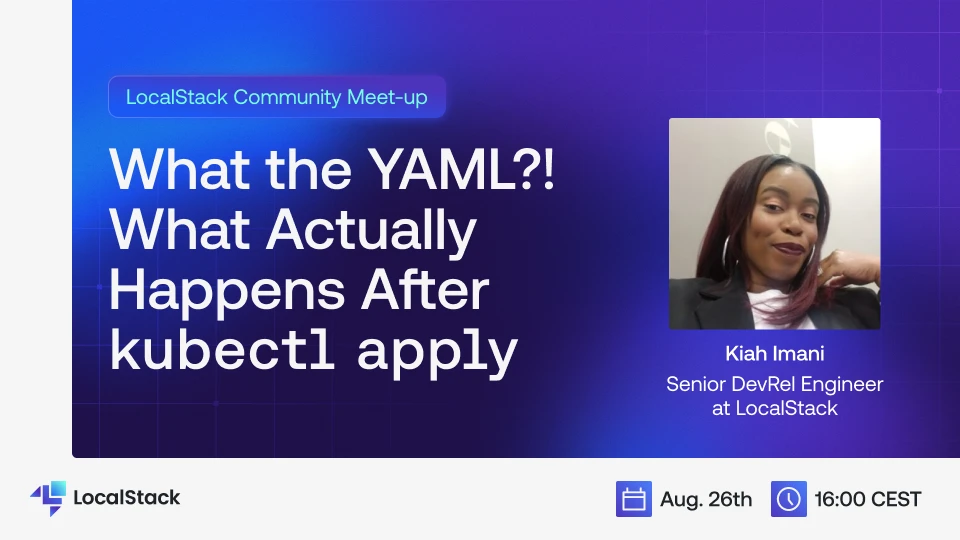
Developers are used to running kubectl apply and waiting on the magic to happen resulting in a running Kubernetes pod. But what actually happens between entering the command and the deployment being ready? What's the reality behind the "magic"? In this talk, Kiah will dissect all the stages of a Kubernetes deployment in a way that is easy to understand. She'll walk through that deployment happening locally on LocalStack to inspect what's really going on at each stage. At the end of this session, attendees will have a deeper understanding of the Kubernetes deployment process that can help debug many common issues and will gain an understanding of how LocalStack enables local testing of Kubernetes.
Have a talk idea?
Do you want to present at our events? We are not just limited to LocalStack—Talks around AWS, Developer Productivity, Cloud Security, DevOps toolings, Development & Testing loops, Snowflake and more would add great value to our members. Fill out the form to propose your talk at one of our Community Events
Previous Talks
Running your Spring Boot app on AWS for production is common, but testing there can be slow and costly. In this video, we’ll show you how to speed up development using LocalStack. By provisioning your infrastructure with Terraform, you can easily switch to local testing in just three steps: configure your dev environment variables, start LocalStack in Docker, and run your IaC files. Get faster feedback and reduce costs by testing locally with LocalStack!
In this live session, WireMock CTO Tom Akehurst will introduce hybrid API simulation (local + cloud) with WireMock Runner. Tom will explain why we built Runner, how developers are using it today, and how it fits into modern dev and test workflows - such as simulating APIs during testing, prototyping, and AI-native development.
LocalStack Chaos API enables you to simulate outages in any AWS region or service. Chaos API provides an easy way to implement chaos engineering experiments to test a wide variety of simulated outages and failures within your application safely, without impacting your production users. Common examples can include region-wide outages, DNS failovers, service failures, and network faults. All the testing scenarios described above can be executed within LocalStack, providing thorough coverage for critical situations in a matter of minutes rather than hours or days. In this presentation by Viren Nadkarni, we explore how Chaos API is leveraged to perform service failures in a local environment while using robust error handling to address and mitigate such issues.
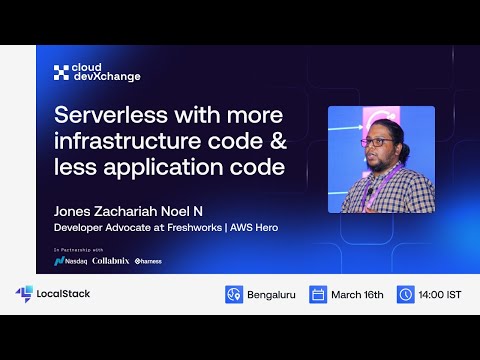
With the growing Serverless workloads, managing and maintaining them is best recommended with Infrastructure as Code (IaC). While this holds the complete infrastructure and its configurations, we could have events from one service destined to another via configuration. When building these configurations, we could also reduce the application code making it more maintainable and scalable. In this session, Jones walked us through a fully end-to-end solution built with Amazon EventBridge and AWS Step Functions with SDK integrations which have helped him to improvise the application with just IaC and very minimal application code.

Tired of rebuilding your stack from scratch every time you run tests or restart your dev environment? In this episode, we dive into Cloud Pods, LocalStack’s powerful state management feature. You’ll learn how to snapshot your entire LocalStack environment (services, resources, data), restore that exact state across machines, teams, or CI runs, speed up test cycles and workflows, and use Cloud Pods to make testing in CI/CD faster and more reliable. Cloud Pods let you freeze your infrastructure in time. Perfect for repeatable tests, isolated dev environments, or onboarding new teammates.
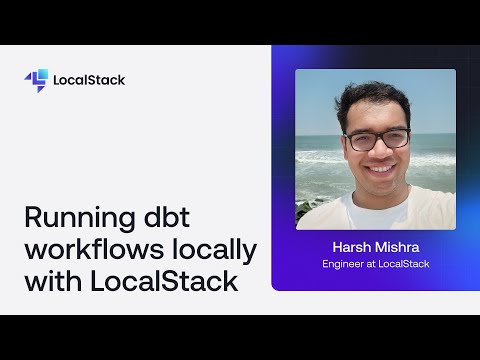
dbt (Data Build Tool) helps data engineers manage data transformations using modular SQL and brings version control, testing, and documentation to their transformation logic. However, running dbt against production data warehouses like Snowflake can be slow, expensive, and risky. This session introduces a new way to develop and test dbt workflows locally using the Snowflake emulator in LocalStack. You'll learn how to set up a local dbt environment, configure dbt to connect to the Snowflake emulator, run and validate dbt models locally without using a real Snowflake account, and iterate quickly on transformations before pushing them to production. Through a hands-on factory app example, we’ll walk through how to use the Snowflake emulator to run dbt models on your laptop, helping you test logic, catch issues early, and reduce cloud costs.
Launch yourself in the world of local cloud development
