Upcoming Events
Meet LocalStack at AWS re:Invent 2026: book a 15-minute booth demo, join the localhost:2026 afterparty and keynote breakfast, and play Stack Escape.
Don’t spend the first morning of AWS re:Invent fighting through the crowds to catch the keynote.
On Tuesday, December 1, LocalStack will livestream the AWS re:Invent keynote at a private breakfast event for our community of customers.
The event will kick off at 7 am PST with free breakfast and discussions about emerging use cases among our community and upcoming LocalStack product capabilities.
Then we will livestream the AWS re:Invent keynote so you don’t miss any of the big news.
Once we wrap up, we’re just a short walk to the convention center, so you can start the day off right before heading into a busy day at re:Invent.
Agenda
- 7:00 am PST: Doors open. Come on in and grab some breakfast!
- 7:30 am PST: LocalStack product discussions begin
- 8:30 am PST: Livestream begins: AWS re:Invent keynote with AWS CEO Matt Garman
- 10:30 am – 12:00 pm PST: Networking and open discussion
Space is limited, so submit the form to add yourself to the waitlist.
It’s time to bring the local cloud community together. AWS re:Invent is just the place.
Whether you’ve spent years building locally or you’re just learning about local cloud development for the first time, localhost:2026 is the AWS re:Invent afterparty for you. Join us for a break from the re:Invent show floor and a chance to connect with your peers in the local cloud community.
Event details
- Date: Wednesday, December 2, 2026
- Time: 6:00 – 9:00 PM PST
- Venue: Cabo Wabo Cantina Las Vegas, Planet Hollywood Resort & Casino, 3663 Las Vegas Blvd South, Las Vegas, NV 89108
Submit the form to RSVP and we’ll make sure you receive everything you need directly in your inbox.
Have a talk idea?
Do you want to present at our events? We are not just limited to LocalStack—Talks around AWS, Developer Productivity, Cloud Security, DevOps toolings, Development & Testing loops, Snowflake and more would add great value to our members. Fill out the form to propose your talk at one of our Community Events
Previous Talks
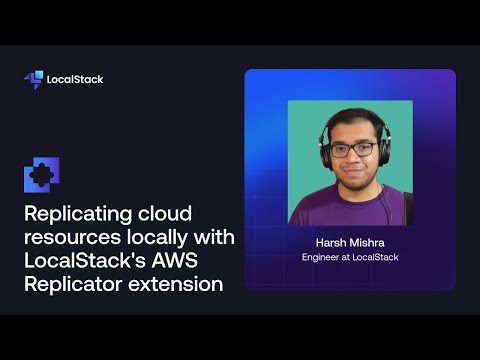
LocalStack's core cloud emulator lets you emulate various cloud services on your own computer. This means you can develop and test your cloud-based solutions without connecting to a remote cloud. However, there are times when you need to seamlessly switch between your local setup and actual cloud resources, especially in hybrid situations. For instance, you might want to share a database with your local Lambda function or access S3 files stored remotely while running a Glue ETL job locally. With LocalStack's AWS Replicator extension, your local environment can replicate AWS cloud resources at the API level, allowing direct interaction with cloud services. The Replicator extension enables you to forward specific requests from LocalStack to AWS without complex proxy setups, and create test scenarios that involve a mix of local and cloud resources.
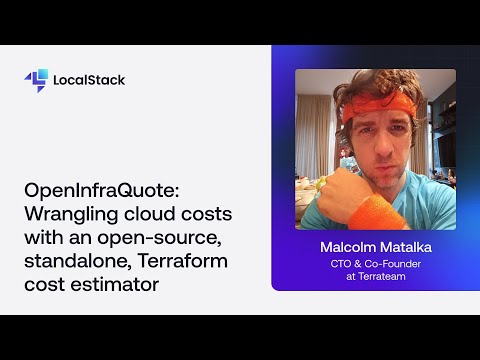
Cloud infrastructure has fueled innovation for nearly two decades—yet cost control remains a challenge. Unforeseen expenses and complicated billing can hamper agility, forcing teams to overspend just to stay competitive. What if you could evaluate costs in real-time, identify inefficiencies, and optimize deployments—without slowing development? Imagine adjusting parameters based on on-the-fly estimates and usage. In this presentation, Malcolm Matalka, Co-founder and CTO of Terrateam, explores how OpenInfraQuote, a new open-source command-line tool, transforms Terraform and OpenTofu code into actionable cost insights. Learn how to automate price checks, compare scenarios, and avoid financial surprises—alongside how it differs from other solutions and how to integrate it into your workflow.
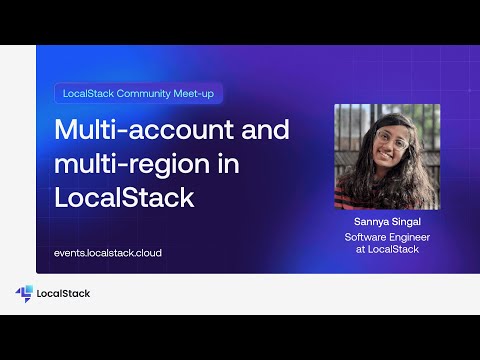
Multi-account and multi-region compatibility enables users to manage and deploy resources across multiple AWS accounts and geographic regions. This functionality enhances the robustness of the deployments by offering improved fault tolerance, scalability, and regulatory compliance. By segregating resources into separate accounts and distributing them across various regions, users can minimize the impact of potential failures and optimize performance. In this session from LocalStack Community Meetup May '24, Sannya Singhal discussed how you could use LocalStack to emulate multi-account and multi-region environments locally for testing and development purposes, ensuring that applications were resilient and scalable before deployment to the cloud.
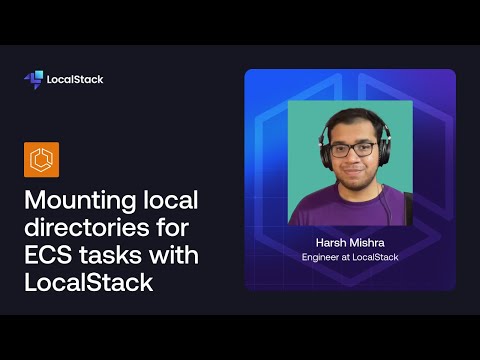
LocalStack's cloud emulator lets you run Amazon Elastic Container Service (ECS) clusters and tasks on your local computer. It's sometimes useful to mount code from the host filesystem directly into the ECS container. This helps quickly test changes without needing to rebuild and redeploy the ECS Task's Docker image each time. This video explains how to use code mounting with the ECS bind mounts feature.
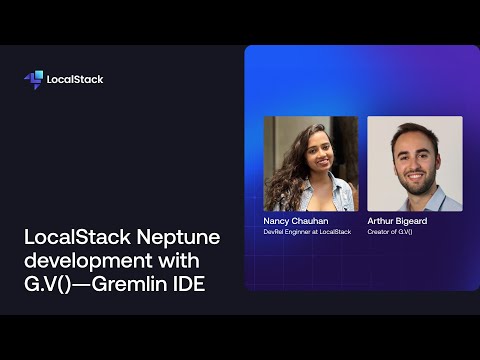
We’re partnering with gdotv to simplify development with our Amazon Neptune cloud emulator component. You can now easily query, visualise and model your graph data either interactively or using the Gremlin querying language with G.V() - Gremlin IDE. With G.V(), you can considerably enhance your graph database development experience whilst gaining access to a powerful reporting and visualisation toolset for your production data. With LocalStack’s core cloud emulator, parity is ensured between a local Neptune instance and AWS’s own, meaning Gremlin queries in your development environment will behave identically on Amazon Neptune. In this video we demonstrate how to use G.V() with LocalStack Neptune.
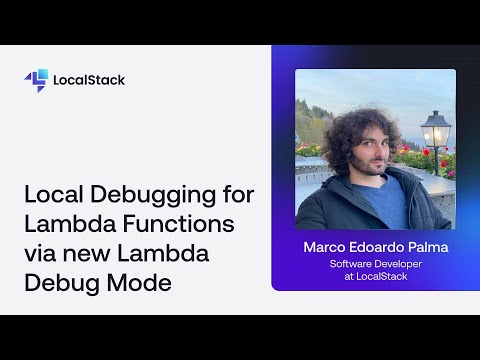
Debugging serverless functions has always been challenging, often requiring repeated invocations, extensive log tracing, and cloud deployments to diagnose an issue. The new Lambda Debug Mode in LocalStack changes this by allowing developers to debug AWS Lambda functions directly in their IDE, with breakpoints, variable inspection, and step-through execution, without leaving their local environment. In this presentation, Marco Edoardo Palma provides a hands-on demo of Lambda Debug Mode—from debugging standalone functions to handling multi-function workflows. Learn how this developer-first approach makes debugging serverless applications faster, smoother, and more intuitive.