
LocalStack Resource Library
Explore the LocalStack Resource Library to unlock the full potential of local cloud development. From quick-start tutorials and deep-dive technical guides to best practices and webinars, we've gathered all the insights you need to build, test, and scale your cloud applications seamlessly.
Browse by Category
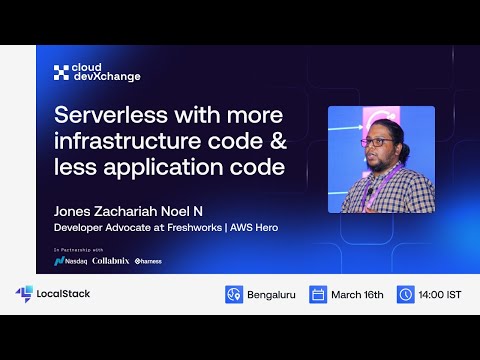
With the growing Serverless workloads, managing and maintaining them is best recommended with Infrastructure as Code (IaC). While this holds the complete infrastructure and its configurations, we could have events from one service destined to another via configuration. When building these configurations, we could also reduce the application code making it more maintainable and scalable. In this session, Jones walked us through a fully end-to-end solution built with Amazon EventBridge and AWS Step Functions with SDK integrations which have helped him to improvise the application with just IaC and very minimal application code.
Tired of rebuilding your stack from scratch every time you run tests or restart your dev environment? In this episode, we dive into Cloud Pods, LocalStack’s powerful state management feature. You’ll learn how to snapshot your entire LocalStack environment (services, resources, data), restore that exact state across machines, teams, or CI runs, speed up test cycles and workflows, and use Cloud Pods to make testing in CI/CD faster and more reliable. Cloud Pods let you freeze your infrastructure in time. Perfect for repeatable tests, isolated dev environments, or onboarding new teammates.
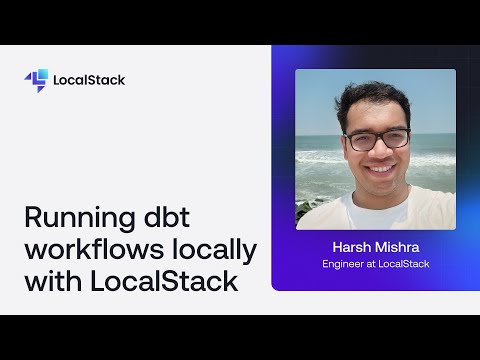
dbt (Data Build Tool) helps data engineers manage data transformations using modular SQL and brings version control, testing, and documentation to their transformation logic. However, running dbt against production data warehouses like Snowflake can be slow, expensive, and risky. This session introduces a new way to develop and test dbt workflows locally using the Snowflake emulator in LocalStack. You'll learn how to set up a local dbt environment, configure dbt to connect to the Snowflake emulator, run and validate dbt models locally without using a real Snowflake account, and iterate quickly on transformations before pushing them to production. Through a hands-on factory app example, we’ll walk through how to use the Snowflake emulator to run dbt models on your laptop, helping you test logic, catch issues early, and reduce cloud costs.
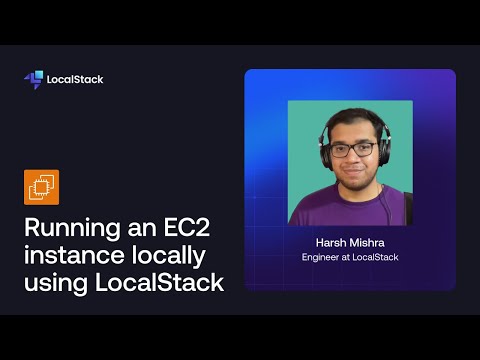
In this video, you'll learn how you can run an Elastic Compute Cloud (EC2) instance locally using LocalStack's core cloud emulator. Elastic Compute Cloud (EC2) is a core service within Amazon Web Services (AWS) that provides scalable and flexible virtual computing resources. EC2 enables users to launch and manage virtual servers, commonly referred to as instances. LocalStack is a core cloud emulator that allows you run EC2 instances using a Docker backend. Under the hood, LocalStack spins another Docker container that mimics an EC2 instance functionality, including other add-on features such as EBS, IMDS, and Load Balancers. Corrections: LocalStack will no longer provide the Ubuntu 20.04 Docker AMI (used in this video) by default in the next major release, though it can still be manually added, and on nine minutes & nine seconds mark, we meant 'localhost' instead of 'localstack'. To access the web server, you can hit the localhost:8000 endpoint as shown in the video.
Get started with LocalStack in minutes! In this episode, we’ll clone a ready-to-go AWS sample app, spin up LocalStack, and run everything locally without a cloud account. By the end, you’ll have a fully functional event-driven app running on your machine.
Bedrock is a fully managed service provided by Amazon Web Services (AWS) that makes foundation models from various LLM providers accessible via an API. LocalStack allows you to use the Bedrock APIs to test and develop AI-powered applications in your local environment. In this video, Silvio showcases how LocalStack 4.0, with our new Bedrock support, is keeping up with advancements in Generative AI (GenAI) and large language Model (LLM) ecosystems. You'll learn what Amazon Bedrock is, the benefits of Bedrock emulation, and a live demo of how it works.
LocalStack's core cloud emulator lets you emulate various cloud services on your own computer. This means you can develop and test your cloud-based solutions without connecting to a remote cloud. However, there are times when you need to seamlessly switch between your local setup and actual cloud resources, especially in hybrid situations. For instance, you might want to share a database with your local Lambda function or access S3 files stored remotely while running a Glue ETL job locally. With LocalStack's AWS Replicator extension, your local environment can replicate AWS cloud resources at the API level, allowing direct interaction with cloud services. The Replicator extension enables you to forward specific requests from LocalStack to AWS without complex proxy setups, and create test scenarios that involve a mix of local and cloud resources.
Cloud infrastructure has fueled innovation for nearly two decades—yet cost control remains a challenge. Unforeseen expenses and complicated billing can hamper agility, forcing teams to overspend just to stay competitive. What if you could evaluate costs in real-time, identify inefficiencies, and optimize deployments—without slowing development? Imagine adjusting parameters based on on-the-fly estimates and usage. In this presentation, Malcolm Matalka, Co-founder and CTO of Terrateam, explores how OpenInfraQuote, a new open-source command-line tool, transforms Terraform and OpenTofu code into actionable cost insights. Learn how to automate price checks, compare scenarios, and avoid financial surprises—alongside how it differs from other solutions and how to integrate it into your workflow.
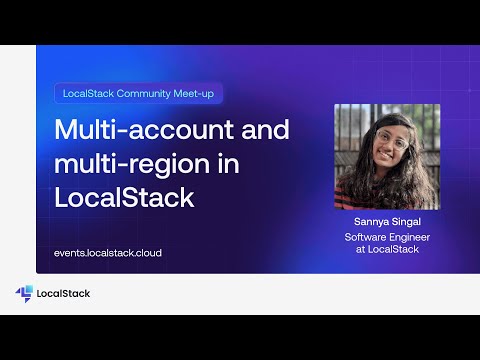
Multi-account and multi-region compatibility enables users to manage and deploy resources across multiple AWS accounts and geographic regions. This functionality enhances the robustness of the deployments by offering improved fault tolerance, scalability, and regulatory compliance. By segregating resources into separate accounts and distributing them across various regions, users can minimize the impact of potential failures and optimize performance. In this session from LocalStack Community Meetup May '24, Sannya Singhal discussed how you could use LocalStack to emulate multi-account and multi-region environments locally for testing and development purposes, ensuring that applications were resilient and scalable before deployment to the cloud.
