
Upcoming Events
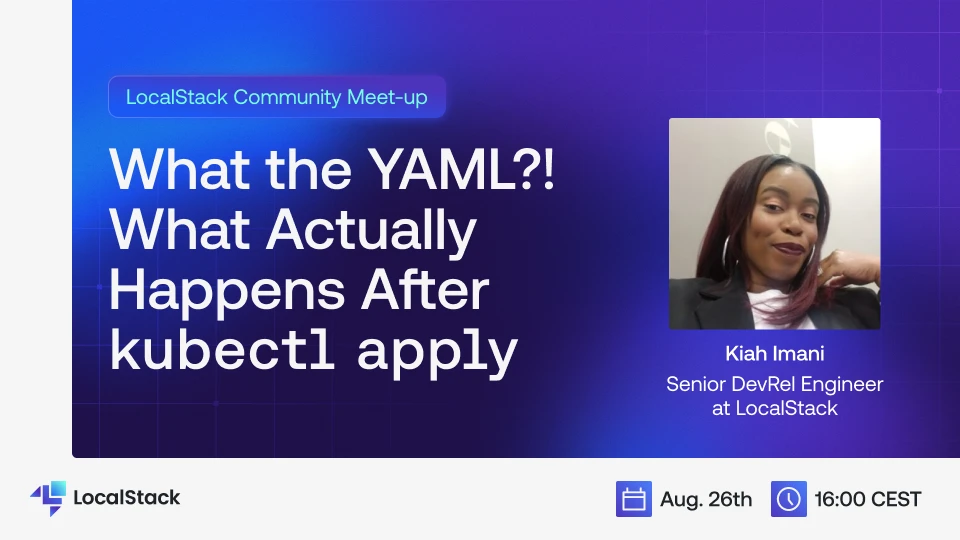
Developers are used to running kubectl apply and waiting on the magic to happen resulting in a running Kubernetes pod. But what actually happens between entering the command and the deployment being ready? What's the reality behind the "magic"? In this talk, Kiah will dissect all the stages of a Kubernetes deployment in a way that is easy to understand. She'll walk through that deployment happening locally on LocalStack to inspect what's really going on at each stage. At the end of this session, attendees will have a deeper understanding of the Kubernetes deployment process that can help debug many common issues and will gain an understanding of how LocalStack enables local testing of Kubernetes.
Have a talk idea?
Do you want to present at our events? We are not just limited to LocalStack—Talks around AWS, Developer Productivity, Cloud Security, DevOps toolings, Development & Testing loops, Snowflake and more would add great value to our members. Fill out the form to propose your talk at one of our Community Events
Previous Talks
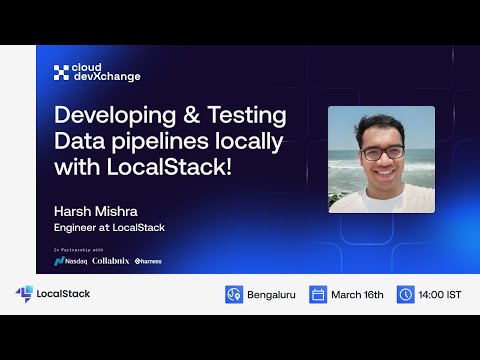
Creating data pipelines and applications for the cloud comes with challenges like a complicated developer experience, dealing with managed cloud dependencies, and enduring long build times. These issues often disrupt your development and testing cycles. LocalStack's cloud emulation allows you to construct, deploy, and test data pipelines on your local machine. It facilitates integration testing of cloud solutions both locally and in CI pipelines. This approach saves time and money, enhances developer velocity, and supports high-quality, agile, test-driven development. In this talk, Harsh delves into developing and testing cloud-based data pipelines on your local machine. The session will provide a firsthand look at the new Snowflake emulator and demonstrate how you can use LocalStack to create Snowflake warehouses, databases, schemas, and tables, and integrate frameworks like Snowpark.
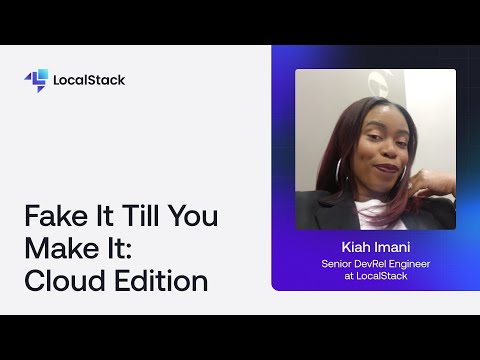
Building and debugging cloud-native applications often involves slow CI/CD pipelines, hard-to-reproduce bugs, and the need for costly shared environments. LocalStack offers a better way — letting developers simulate real AWS services entirely on their local machine. In this presentation, Kiah Imani gives a hands-on walkthrough of building and testing AWS workflows locally with LocalStack. From Lambda functions to S3 pre-signed uploads and SNS/SQS pipelines, you'll see how to prototype, debug, and iterate on cloud-native apps without ever deploying to the cloud.
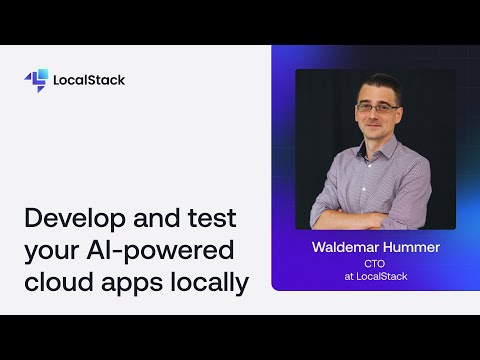
Running AI/ML workloads in the cloud can be expensive, opaque, and difficult to iterate on. LocalStack changes this by enabling engineers to develop and test AI-powered cloud applications entirely locally, emulating services like SageMaker, Bedrock, Redshift, and Snowflake. In this presentation, Waldemar Hummer, CTO of LocalStack, demonstrates how to prototype and validate AI & ML data pipelines safely and cost-effectively using LocalStack’s cloud emulators. You’ll see how to emulate complex AI workflows, test integrations, and use “vibe coding” techniques confidently in a fully sandboxed local environment.
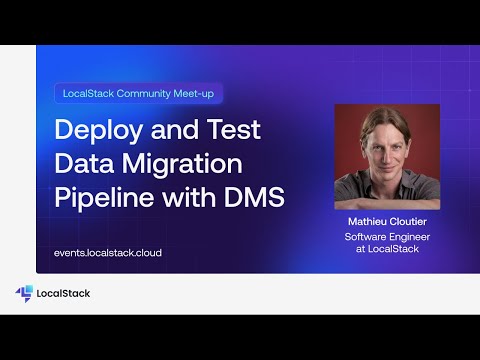
AWS Database Migration Service provides migration solutions from databases, data warehouses, and other types of data stores (e.g. S3, SAP). The migration can be homogeneous (source and target have the same type), but often is heterogeneous as it supports migration from various sources to various targets (self-hosted and AWS services). LocalStack supports DMS with selected use cases. In this session from LocalStack Community Meetup July '24, Mathieu Cloutier explores how to use LocalStack to migrate from a MariaDB database to an AWS Kinesis Stream. He goes over the differences between CDC and full load, and as a bonus you will see how easy it is to migrate from an external database to your Kinesis Stream — tested all on your local machine!
How much faster could your cloud application release cycles move if your developers didn’t need to deploy code to the cloud?
Local cloud development eliminates the security implications, cost concerns, and access restrictions of traditional cloud development by replicating production-quality application environments on local infrastructure.
Join us on Tuesday, December 16, at 1pm eastern time for a live demo webinar to learn more about how LocalStack replicates production-quality AWS application environments on local infrastructure, the unique advantages that local cloud environments provide for software developers, and successful use cases where local cloud development unlocks velocity that developers can’t experience on the cloud.
Even if you’re not available to join the livestream, sign-up here to receive the session recording in your inbox.
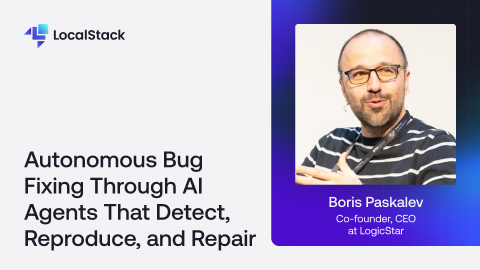
What if your software could fix its own bugs—before anyone even notices them? In this session, LogicStar co-founder Boris Paskalev shares how self-healing applications are becoming a reality—fixing bugs automatically, before they reach production or immediately after an issue is detected/reported. LogicStar combines classical computer science, deep tech research from the pioneers of “AI for Code” and Agentic AI to detect, reproduce, and fix real production issues with validated, test-backed pull requests. This session is for engineering leaders, PMs, and AI builders ready to rethink the boundaries of autonomy in software delivery.
Launch yourself in the world of local cloud development
