
Upcoming Events
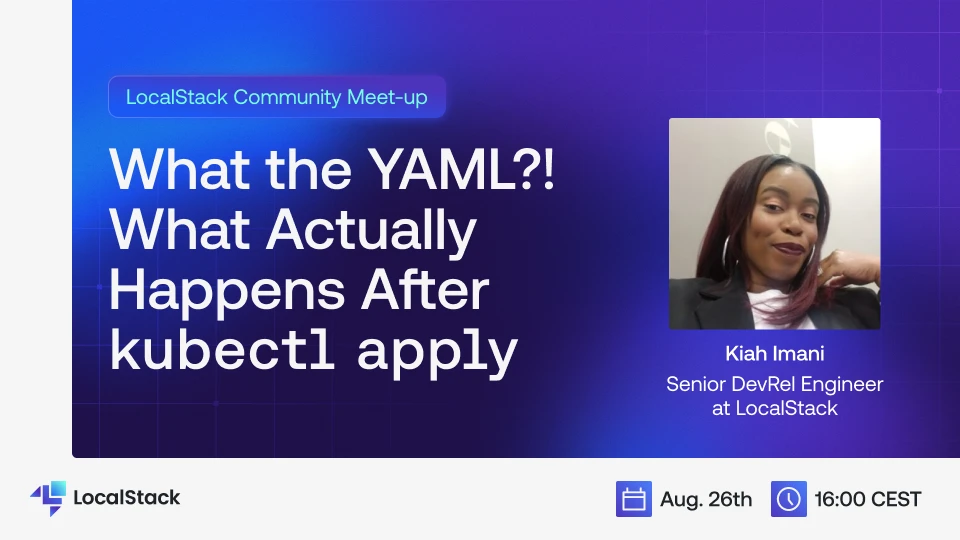
Developers are used to running kubectl apply and waiting on the magic to happen resulting in a running Kubernetes pod. But what actually happens between entering the command and the deployment being ready? What's the reality behind the "magic"? In this talk, Kiah will dissect all the stages of a Kubernetes deployment in a way that is easy to understand. She'll walk through that deployment happening locally on LocalStack to inspect what's really going on at each stage. At the end of this session, attendees will have a deeper understanding of the Kubernetes deployment process that can help debug many common issues and will gain an understanding of how LocalStack enables local testing of Kubernetes.
Have a talk idea?
Do you want to present at our events? We are not just limited to LocalStack—Talks around AWS, Developer Productivity, Cloud Security, DevOps toolings, Development & Testing loops, Snowflake and more would add great value to our members. Fill out the form to propose your talk at one of our Community Events
Previous Talks
Modern software systems operate in complex, dynamic environments where failures are inevitable. Traditional monitoring and manual incident response are no longer sufficient to ensure resilience or customer satisfaction. This talk explores how to design and implement self-healing software systems by combining telemetry data with an AI-driven agentic approach. We’ll start by examining how high-quality telemetry forms the foundation for detecting anomalies and predicting failures. Next, we’ll show how modern GenAI (LLMs) can transform this telemetry into actionable insights for AI agents that interpret data, pinpoint root causes, and apply automated fixes. Through a practical, real-world example, you’ll see how telemetry and AI work together to create adaptive feedback loops that continuously improve system reliability, while freeing engineers from repetitive operational tasks.
LocalStack’s core cloud emulator allows us to run our own cloud application - including its infrastructure - locally, which provides an efficient developer experience at the start of the entire software development lifecycle (SDLC). This experience enables us to build our product features in a way that closely matches what our customers are looking for — a comprehensive developer platform that facilitates local multi-cloud development across different providers and services. In this session from LocalStack Community Meetup April '24, Lukas Pichler showcases how to use the LocalStack core cloud emulator and other novel solutions, to build, test, and integrate new features in our LocalStack Web Application. He covers an application overview, how we enable local cloud development, how we use LocalStack in CI, and how we use LocalStack to enable application previews and E2E testing.
What happens when your cloud services fail? 💥 In this final episode of our series, we dive into the LocalStack Chaos Dashboard to simulate real-world outages—like DynamoDB errors—and see how your app responds under pressure. Learn how to intentionally break your systems locally so you can ship more resilient applications in production.
Bring your tests to CI/CD with GitHub Actions! In this episode, we’ll show how to integrate LocalStack into your workflow, so your tests run automatically on every push without touching real AWS resources. Whether you're testing Lambda, DynamoDB, S3, or beyond LocalStack makes it possible to run everything locally, even in your CI workflows.
Check out the recording of the hands-on webinar featuring Yan Cui, AWS Serverless Hero, and Waldemar Hummer, CTO of LocalStack, to learn practical use cases around monitoring serverless applications for local dev&test loops. Learn the best practices for debugging serverless applications using various AWS services to support your serverless workflows while troubleshooting errors and performance issues. In this video, you will learn about building and deploying Serverless apps locally, common patterns and workflows for testing Serverless apps, troubleshooting errors and performance issues in dev&test loops, implementing observability with distributed tracing with Lumigo, and local Serverless development with LocalStack.
In this talk, Teja explore the intricacies of the software supply chain and discuss strategies for protecting your software against supply chain attacks. He look sinto the risks associated with these threats, offer mitigation measures, and covers recommended practices for managing open-source software and Software Bills of Materials (SBOMs). This session aims to equip the audience with the knowledge and tools needed to enhance the security of their software supply chain.
Launch yourself in the world of local cloud development
