
Upcoming Events
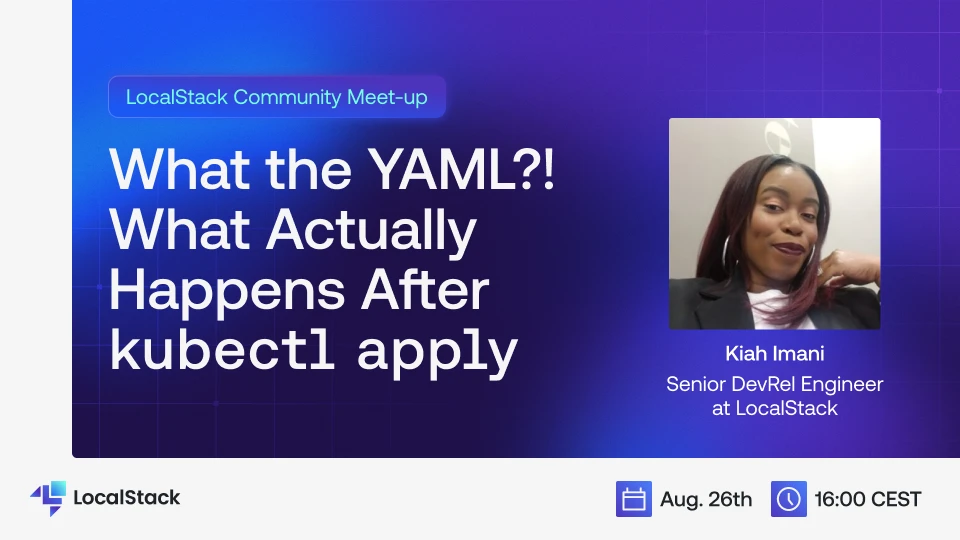
Developers are used to running kubectl apply and waiting on the magic to happen resulting in a running Kubernetes pod. But what actually happens between entering the command and the deployment being ready? What's the reality behind the "magic"? In this talk, Kiah will dissect all the stages of a Kubernetes deployment in a way that is easy to understand. She'll walk through that deployment happening locally on LocalStack to inspect what's really going on at each stage. At the end of this session, attendees will have a deeper understanding of the Kubernetes deployment process that can help debug many common issues and will gain an understanding of how LocalStack enables local testing of Kubernetes.
Have a talk idea?
Do you want to present at our events? We are not just limited to LocalStack—Talks around AWS, Developer Productivity, Cloud Security, DevOps toolings, Development & Testing loops, Snowflake and more would add great value to our members. Fill out the form to propose your talk at one of our Community Events
Previous Talks
What if your AI coding assistant could not only write infrastructure code, but also deploy it, test it, and fix issues automatically — all on your local machine? That's exactly what the LocalStack MCP Server makes possible. In this session, we'll introduce the LocalStack Model Context Protocol (MCP) Server, a new tool that lets AI agents manage your entire local cloud development lifecycle through a conversational interface. You'll learn what MCP is and why it's a game-changer for AI-assisted development, how the LocalStack MCP Server turns manual cloud tasks into automated workflows, how to set up and configure the server with your favorite AI editor (Cursor, VS Code, etc.), and real-world demos: deploying CDK apps, analyzing logs, running chaos tests, managing state with Cloud Pods, and more. Through hands-on examples, we'll walk through a complete workflow where an AI agent deploys a serverless application, verifies resources, troubleshoots issues, and tests resilience, all without leaving the conversation. If you've ever wished your AI assistant could do more than just generate code, this talk will show you what's possible when agents can actually manage your local cloud environment.
Looking to bring AWS emulation directly into your CI/CD pipelines? This hands-on session with Harsh Mishra shows you how to integrate LocalStack with Dagger to level up your development workflows. In this session, you'll learn how to run full AWS emulation locally inside Dagger pipelines, spin up LocalStack as a service using Dagger’s composable syntax, use Cloud Pods for persistent state across pipeline runs, and create ephemeral environments for fast, clean, isolated testing. Keep your cloud workflows repeatable, testable, and fast. Whether you’re building serverless apps, managing infrastructure-as-code, or optimizing your DevOps pipelines, this talk will help you bring LocalStack into the heart of your CI/CD setup.
LocalStack's Docker Extension allows developers to manage and run cloud applications locally within Docker Desktop efficiently. With a fully-integrated experience with features such as configuration profiles, container logs, and more, developers can now easily manage their LocalStack instance. In this video, Harsh from LocalStack discusses the LocalStack Docker Extension and how you can capitalize on an intuitive user experience to manage your LocalStack image, configuration profiles, and container logs directly within the Docker Desktop.
This is where it all comes together. CI/CD lets dev teams ship code automatically — but only if your pipeline is built to handle the cloud. In this episode, I show you how local testing + automated deployment = cloud apps that ship faster, safer, and smarter. Stick around to the end, this is the final episode of WTH is the Cloud?!
The challenge with Machine Learning (ML) models is productionizing. It requires data ingestion, data preparation, model training, model deployment, and monitoring. Adopting MLOps practices is similar to DevOps practices. In MLOps, the workload changes, but some core principles like automation, continuous integration/continuous deployment (CI/CD), and monitoring. Taking DevOps practices, I will discuss the similarities and differences in adopting MLOps practices. In this talk, Chinmay takes a production use case to scale ML models to 2 million+ daily requests. It leverages Google Cloud's (GCP) infrastructure to use its GPU and other services. This talk will help you draw similarities between DevOps and MLOps as a DevOps practitioner and help you learn how to run Machine Learning models at the production scale with best practices.
Testing AWS CI/CD pipelines in the cloud can be slow, error-prone, and hard to debug, especially when you're wrestling with IAM permissions or waiting on long feedback cycles. This session walks through how you can now emulate complete DevOps workflows locally using LocalStack. We cover recent additions to LocalStack that support new service providers such as CodeBuild for running build processes across different runtimes directly on your machine, CodeDeploy for emulating deployment steps without touching the real infrastructure, and CodePipeline for creating and testing CI pipelines, transitions, and triggers locally. Through a live demo, we’ll walk through a working example of a CI/CD pipeline — building a Rust project, deploying it, and running the pipeline stages — all without leaving your laptop. This session is useful for developers building or debugging AWS-native CI/CD workflows and looking for faster, more controlled ways to test them.
Launch yourself in the world of local cloud development
