
LocalStack Resource Library
Explore the LocalStack Resource Library to unlock the full potential of local cloud development. From quick-start tutorials and deep-dive technical guides to best practices and webinars, we've gathered all the insights you need to build, test, and scale your cloud applications seamlessly.
Browse by Category
LocalStack enables organizations to automate their application testing and integration process through DevOps practices, such as continuous integration (CI). LocalStack allows organizations to move away from complicated AWS testing and staging environments by enabling a key component of testing and delivering cloud-native applications. To further automate the process, we use Infrastructure-as-Code (IaC) frameworks like Terraform that allow you to create your resources declaratively and apply those resources. Testing your Terraform modules against the real AWS cloud can be time-consuming and costly and can make you run into the risk of dangling resources after an unsuccessful CI run. Using LocalStack to emulate a mock ephemeral AWS infrastructure on CI pipelines allows you to work on the same functionality the real AWS cloud provides while cutting down testing costs and deployment times. In this session, Jim Sheldon, Senior Developer Advocate at Harness, will demonstrate how to use LocalStack to test Terraform modules on Harness CI. Harness CI allows you to create software pipelines that will enable you to check out your code, build the software, run your tests, and validate every code change. We wind up the session with updates about the all-new LocalStack release!
In this hands-on session, you’ll learn how to level up your serverless development by integrating the AWS Toolkit for VS Code with LocalStack — enabling faster Lambda development, debugging, and testing without needing a live AWS account. 👨💻 Featuring: Joel Scheuner, Senior Software Engineer at LocalStack, will show you how to configure the AWS Toolkit for VS Code to connect with LocalStack, deploy and test Lambda functions locally with full AWS emulation, set breakpoints and debug functions right from your IDE, and iterate quickly on code changes with minimal setup overhead. You’ll also hear from an AWS engineer sharing real-world insights and best practices for modern serverless workflows. Whether you’re new to serverless or already deep in AWS development, this session will help you code with confidence and streamline your Lambda workflow from start to finish — all from your laptop.
LocalStack is a cloud service emulator designed for local development and testing of cloud applications. With LocalStack, you can test AWS CloudWatch metric alarms, to get notified on infrastructure failures — all on your local machine! In this video, you will learn how you can use a CloudWatch metric alarm to get notified automatically when your Lambda function invocations fail. You will also set up an email notification using the Simple Email Service (SES) and our Mailhog extension.

Testing in the cloud = slow builds, fragile staging, surprise bills. Let’s talk about how developers are flipping the script and using local cloud environments to test smarter, faster, and cheaper without breaking production. Bonus: You’ll learn how LocalStack lets you simulate AWS on your machine. Game changer.
Why wait for the cloud to test your app? In this episode, we’ll write and run an integration test to validate our LocalStack app. You’ll learn how to upload a file, trigger the Lambda-SQS-DynamoDB flow, and assert the results all locally.
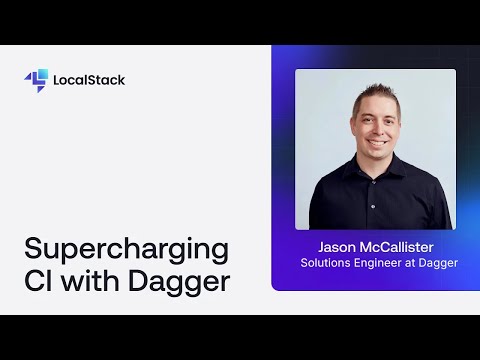
Want to modernize your CI/CD workflows? 🚀 In this session, Jason McCallister introduces Dagger, the open-source programmable CI/CD engine that’s redefining how we build, test, and ship software. You'll learn what makes Dagger different from traditional CI/CD tools, how to write pipelines as code and run them locally, how to compose reusable, testable pipeline components, real-world examples of solving CI headaches with Dagger, and integration tips with Docker, Kubernetes, and beyond. Whether you’re a DevOps pro, platform engineer, or just tired of brittle YAML, this talk will show you how Dagger helps you ship faster and smarter.
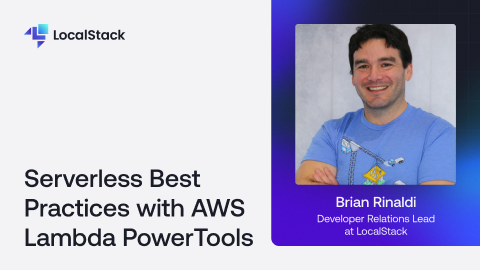
For one-off tasks, AWS Lambda really can be incredibly easy. You write a few lines of code, deploy it, and you have a function running in the cloud ready to respond to events, scale automatically, and that only costs you pennies. But as your application grows, so does some necessary complexity. When a few one-off functions become a full serverless backend architecture made up of interconnected services, you’ll need to pay careful attention to best practices to ensure that your application is easy to debug, maintain, and scale. That’s where AWS Powertools for Lambda fits in. It’s a suite of reusable utilities designed to simplify bringing best practices around things like logging, tracing, metrics, idempotency and more to your Lambda functions with minimal effort. This demo session will dive into some of the functionality provided by the AWS Powertools (TypeScript) core libraries, such as encapsulating best practices into reusable libraries for structured logging, metrics collection, idempotency, and more; leveraging Middy middleware to integrate common cross-cutting concerns, such as injecting Lambda context or automatically flushing metric; enabling local testing with LocalStack, allowing you to deploy and debug Lambda functions with structured logs, trace data, and embedded metrics; and providing modular examples that can be deployed to AWS or LocalStack with ease, enabling developers to explore libraries.
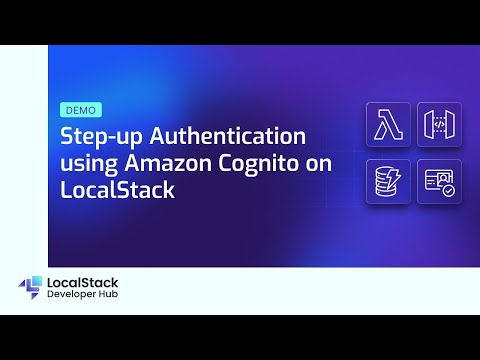
LocalStack Applications in Developer Hub provides sample templates to help LocalStack users adopt real-world scenarios to rapidly and conveniently create, configure, and deploy applications locally.
Getting started with Step-up-authentication demo
In this demo, we will setup a step-up authentication workflow for a higher level of security, deployed using Cloud Development Kit on LocalStack
Running your Spring Boot app on AWS for production is common, but testing there can be slow and costly. In this video, we’ll show you how to speed up development using LocalStack. By provisioning your infrastructure with Terraform, you can easily switch to local testing in just three steps: configure your dev environment variables, start LocalStack in Docker, and run your IaC files. Get faster feedback and reduce costs by testing locally with LocalStack!
In this live session, WireMock CTO Tom Akehurst will introduce hybrid API simulation (local + cloud) with WireMock Runner. Tom will explain why we built Runner, how developers are using it today, and how it fits into modern dev and test workflows - such as simulating APIs during testing, prototyping, and AI-native development.
LocalStack Chaos API enables you to simulate outages in any AWS region or service. Chaos API provides an easy way to implement chaos engineering experiments to test a wide variety of simulated outages and failures within your application safely, without impacting your production users. Common examples can include region-wide outages, DNS failovers, service failures, and network faults. All the testing scenarios described above can be executed within LocalStack, providing thorough coverage for critical situations in a matter of minutes rather than hours or days. In this presentation by Viren Nadkarni, we explore how Chaos API is leveraged to perform service failures in a local environment while using robust error handling to address and mitigate such issues.
