For one-off tasks, AWS Lambda really can be incredibly easy. You write a few lines of code, deploy it, and you have a function running in the cloud ready to respond to events, scale automatically, and that only costs you pennies. But as your application grows, so does some necessary complexity. When a few one-off functions become a full serverless backend architecture made up of interconnected services, you’ll need to pay careful attention to best practices to ensure that your application is easy to debug, maintain, and scale. That’s where AWS Powertools for Lambda fits in. It’s a suite of reusable utilities designed to simplify bringing best practices around things like logging, tracing, metrics, idempotency and more to your Lambda functions with minimal effort. This demo session will dive into some of the functionality provided by the AWS Powertools (TypeScript) core libraries, such as encapsulating best practices into reusable libraries for structured logging, metrics collection, idempotency, and more; leveraging Middy middleware to integrate common cross-cutting concerns, such as injecting Lambda context or automatically flushing metric; enabling local testing with LocalStack, allowing you to deploy and debug Lambda functions with structured logs, trace data, and embedded metrics; and providing modular examples that can be deployed to AWS or LocalStack with ease, enabling developers to explore libraries.

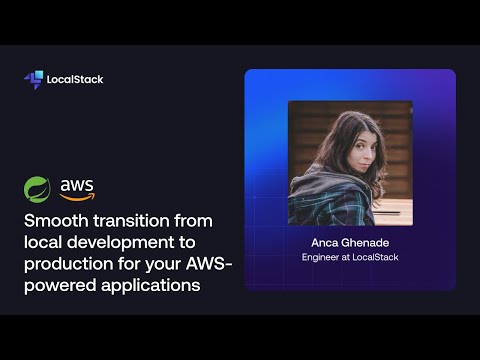
Running your Spring Boot app on AWS for production is common, but testing there can be slow and costly. In this video, we’ll show you how to speed up development using LocalStack. By provisioning your infrastructure with Terraform, you can easily switch to local testing in just three steps: configure your dev environment variables, start LocalStack in Docker, and run your IaC files. Get faster feedback and reduce costs by testing locally with LocalStack!
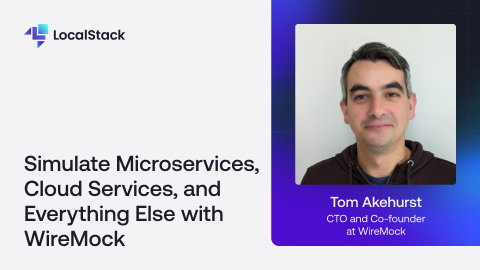
In this live session, WireMock CTO Tom Akehurst will introduce hybrid API simulation (local + cloud) with WireMock Runner. Tom will explain why we built Runner, how developers are using it today, and how it fits into modern dev and test workflows - such as simulating APIs during testing, prototyping, and AI-native development.

LocalStack Chaos API enables you to simulate outages in any AWS region or service. Chaos API provides an easy way to implement chaos engineering experiments to test a wide variety of simulated outages and failures within your application safely, without impacting your production users. Common examples can include region-wide outages, DNS failovers, service failures, and network faults. All the testing scenarios described above can be executed within LocalStack, providing thorough coverage for critical situations in a matter of minutes rather than hours or days. In this presentation by Viren Nadkarni, we explore how Chaos API is leveraged to perform service failures in a local environment while using robust error handling to address and mitigate such issues.