

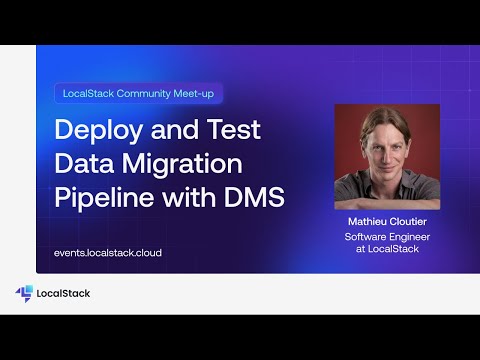
AWS Database Migration Service provides migration solutions from databases, data warehouses, and other types of data stores (e.g. S3, SAP). The migration can be homogeneous (source and target have the same type), but often is heterogeneous as it supports migration from various sources to various targets (self-hosted and AWS services). LocalStack supports DMS with selected use cases. In this session from LocalStack Community Meetup July '24, Mathieu Cloutier explores how to use LocalStack to migrate from a MariaDB database to an AWS Kinesis Stream. He goes over the differences between CDC and full load, and as a bonus you will see how easy it is to migrate from an external database to your Kinesis Stream — tested all on your local machine!
How much faster could your cloud application release cycles move if your developers didn’t need to deploy code to the cloud?
Local cloud development eliminates the security implications, cost concerns, and access restrictions of traditional cloud development by replicating production-quality application environments on local infrastructure.
Join us on Tuesday, December 16, at 1pm eastern time for a live demo webinar to learn more about how LocalStack replicates production-quality AWS application environments on local infrastructure, the unique advantages that local cloud environments provide for software developers, and successful use cases where local cloud development unlocks velocity that developers can’t experience on the cloud.
Even if you’re not available to join the livestream, sign-up here to receive the session recording in your inbox.
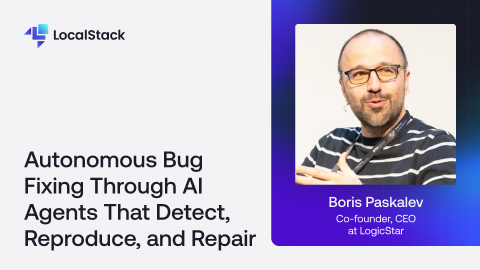
What if your software could fix its own bugs—before anyone even notices them? In this session, LogicStar co-founder Boris Paskalev shares how self-healing applications are becoming a reality—fixing bugs automatically, before they reach production or immediately after an issue is detected/reported. LogicStar combines classical computer science, deep tech research from the pioneers of “AI for Code” and Agentic AI to detect, reproduce, and fix real production issues with validated, test-backed pull requests. This session is for engineering leaders, PMs, and AI builders ready to rethink the boundaries of autonomy in software delivery.
