

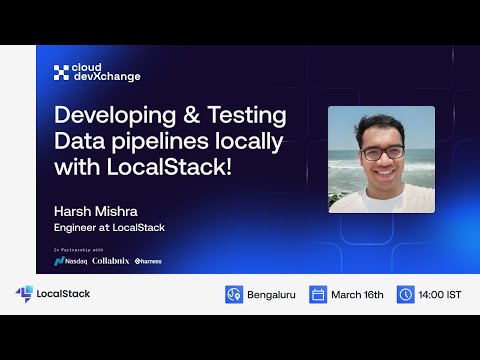
Creating data pipelines and applications for the cloud comes with challenges like a complicated developer experience, dealing with managed cloud dependencies, and enduring long build times. These issues often disrupt your development and testing cycles. LocalStack's cloud emulation allows you to construct, deploy, and test data pipelines on your local machine. It facilitates integration testing of cloud solutions both locally and in CI pipelines. This approach saves time and money, enhances developer velocity, and supports high-quality, agile, test-driven development. In this talk, Harsh delves into developing and testing cloud-based data pipelines on your local machine. The session will provide a firsthand look at the new Snowflake emulator and demonstrate how you can use LocalStack to create Snowflake warehouses, databases, schemas, and tables, and integrate frameworks like Snowpark.
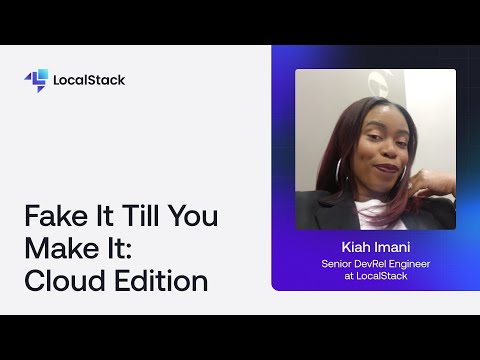
Building and debugging cloud-native applications often involves slow CI/CD pipelines, hard-to-reproduce bugs, and the need for costly shared environments. LocalStack offers a better way — letting developers simulate real AWS services entirely on their local machine. In this presentation, Kiah Imani gives a hands-on walkthrough of building and testing AWS workflows locally with LocalStack. From Lambda functions to S3 pre-signed uploads and SNS/SQS pipelines, you'll see how to prototype, debug, and iterate on cloud-native apps without ever deploying to the cloud.
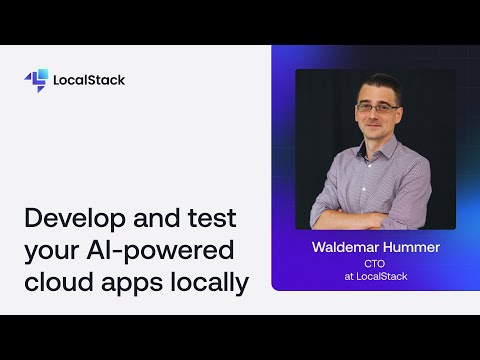
Running AI/ML workloads in the cloud can be expensive, opaque, and difficult to iterate on. LocalStack changes this by enabling engineers to develop and test AI-powered cloud applications entirely locally, emulating services like SageMaker, Bedrock, Redshift, and Snowflake. In this presentation, Waldemar Hummer, CTO of LocalStack, demonstrates how to prototype and validate AI & ML data pipelines safely and cost-effectively using LocalStack’s cloud emulators. You’ll see how to emulate complex AI workflows, test integrations, and use “vibe coding” techniques confidently in a fully sandboxed local environment.
