Executive Briefing: State of AI in Cloud Development 2026

A recent survey of enterprise software developers revealed serious concerns about the tech stack supporting agentic AI workflows. In this 45-minute executive briefing, Colin Neagle, Head of Marketing, and Christian Capdeville, Head of Product Marketing, walk through the findings of the State of AI in Cloud Development 2026 report and share recommendations for a cloud development experience that improves the output of agentic AI workflows without sacrificing velocity.

Key findings

  • 79% of development teams grant AI agents access to cloud development environments, even though 97% expressed concerns about doing so
  • Nearly 40% of AI-generated code never makes it into production, as developers cite quality concerns and ineffective environments for testing code
  • Developers showed far less trust in the quality of AI-generated code than people in manager roles, pointing to a gap between perceived and actual AI maturity

What you'll learn

  • Why agentic AI is testing the limits of traditional cloud development environments: slow provisioning, shared environments, frequent crashes and drift from production
  • How local cloud sandboxes isolate and secure cloud testing for AI agents
  • Three examples in practice: local developer environments, autonomous software factories, and reinforcement learning for LLMs
  • The metrics software teams use to measure impact: deployment frequency, lead time for changes, production incidents, mean time to resolution and cost

Want the full data? Read the State of AI in Cloud Development 2026 report.

Related Talks

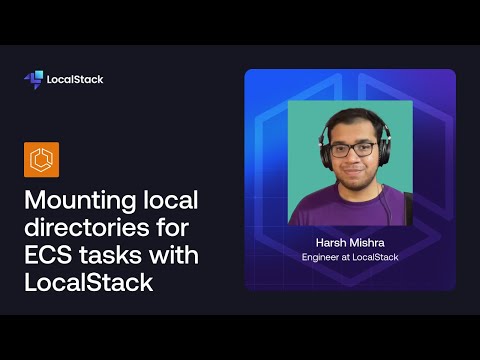
Mounting local directories for ECS tasks with LocalStack

LocalStack's cloud emulator lets you run Amazon Elastic Container Service (ECS) clusters and tasks on your local computer. It's sometimes useful to mount code from the host filesystem directly into the ECS container. This helps quickly test changes without needing to rebuild and redeploy the ECS Task's Docker image each time. This video explains how to use code mounting with the ECS bind mounts feature.
Learn More
Learn More
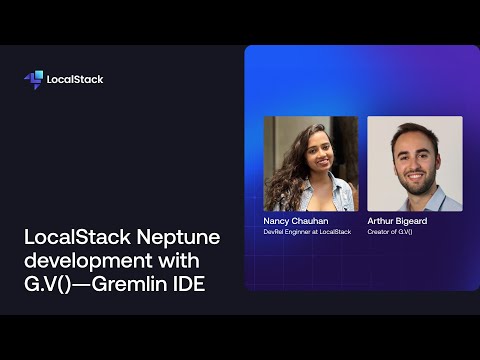
LocalStack Neptune development with G.V() — Gremlin IDE

We’re partnering with gdotv to simplify development with our Amazon Neptune cloud emulator component. You can now easily query, visualise and model your graph data either interactively or using the Gremlin querying language with G.V() - Gremlin IDE. With G.V(), you can considerably enhance your graph database development experience whilst gaining access to a powerful reporting and visualisation toolset for your production data. With LocalStack’s core cloud emulator, parity is ensured between a local Neptune instance and AWS’s own, meaning Gremlin queries in your development environment will behave identically on Amazon Neptune. In this video we demonstrate how to use G.V() with LocalStack Neptune.
Learn More
Learn More
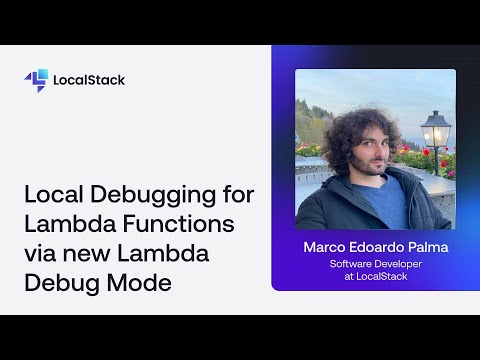
Local Debugging for Lambda Functions via new Lambda Debug Mode

Debugging serverless functions has always been challenging, often requiring repeated invocations, extensive log tracing, and cloud deployments to diagnose an issue. The new Lambda Debug Mode in LocalStack changes this by allowing developers to debug AWS Lambda functions directly in their IDE, with breakpoints, variable inspection, and step-through execution, without leaving their local environment. In this presentation, Marco Edoardo Palma provides a hands-on demo of Lambda Debug Mode—from debugging standalone functions to handling multi-function workflows. Learn how this developer-first approach makes debugging serverless applications faster, smoother, and more intuitive.

Learn More
Learn More

Launch yourself in the world of local cloud development

Try for free
Try for free
Talk to Sales
Talk to Sales