
Upcoming Events
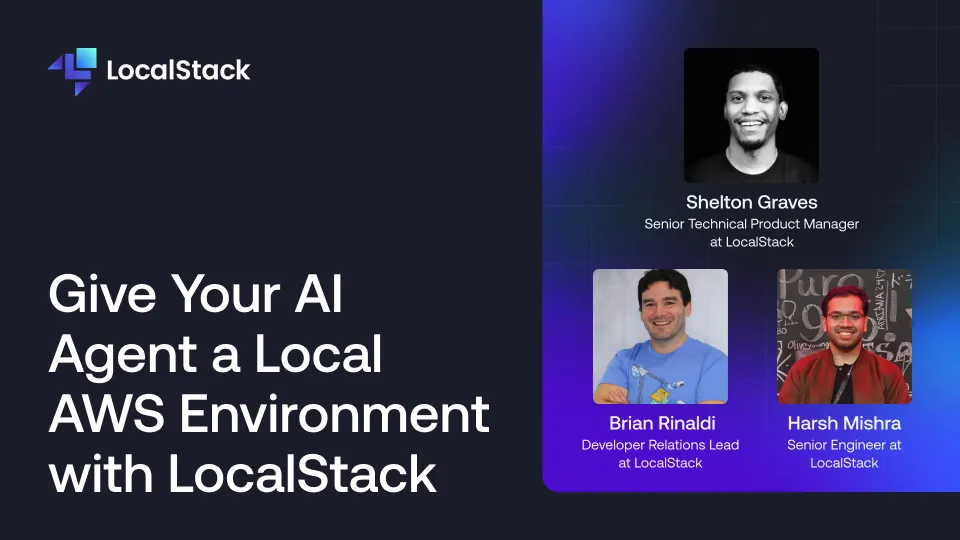
An agent will write you a CDK stack, a Terraform module, or a stack of IAM policies in seconds.
Whether any of it works is a separate question, and the usual way to find out is to deploy to a real AWS account and watch what breaks.
In an agentic workflow, that means giving AI access to a public cloud account, racking up costs on the AWS bill, and waiting for provisioning to complete every time you push new code to the environment.
Join this livestreamed demo on Thursday, June 25, to see how our users:
- Give AI agents a simulated AWS environment that runs locally so they can test for the cloud without access or costs
- Enable agents to deploy and validate code in the local environment
- Review failures, read logs, and validate fixes instantly directly via their agents
- Ship validated code to staging or production by simply swapping the endpoint for your AWS account
Have a talk idea?
Do you want to present at our events? We are not just limited to LocalStack—Talks around AWS, Developer Productivity, Cloud Security, DevOps toolings, Development & Testing loops, Snowflake and more would add great value to our members. Fill out the form to propose your talk at one of our Community Events
Previous Talks
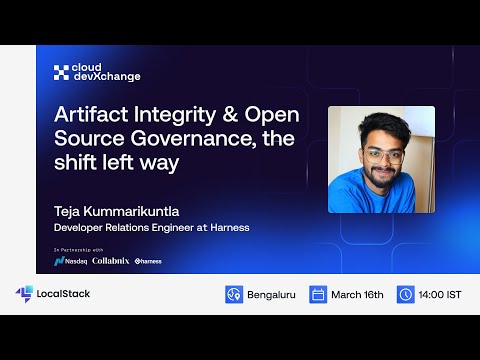
In this talk, Teja explore the intricacies of the software supply chain and discuss strategies for protecting your software against supply chain attacks. He look sinto the risks associated with these threats, offer mitigation measures, and covers recommended practices for managing open-source software and Software Bills of Materials (SBOMs). This session aims to equip the audience with the knowledge and tools needed to enhance the security of their software supply chain.
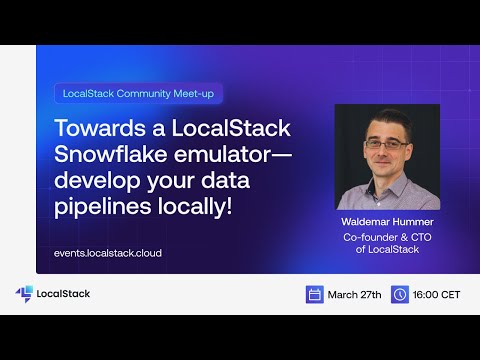
About a year ago we have released the first version of LocalStack Extensions: Extensions are a powerful mechanism to plug additional functionality into LocalStack - ranging from additional service emulators, to value-add features like Chaos Engineering, request logging, cloud resource replication/proxying, and more.Over the last couple of months we have been experimenting with a LocalStack Snowflake emulator extension, which allows to develop and test your Snowflake data pipelines entirely on your local machine!In this talk, Waldemar discusses and demonstrates how you can develop your Snowflake data pipelines locally with LocalStack.
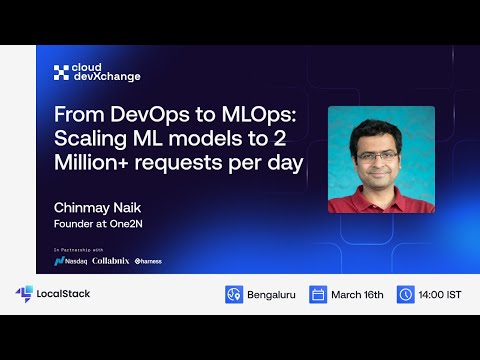
The challenge with Machine Learning (ML) models is productionizing. It requires data ingestion, data preparation, model training, model deployment, and monitoring.Adopting MLOps practices is similar to DevOps practices. In MLOps, the workload changes, but some core principles like automation, continuous integration/continuous deployment (CI/CD), and monitoring. Taking DevOps practices, I will discuss the similarities and differences in adopting MLOps practices.In this talk, Chinmay takes a production use case to scale ML models to 2 million+ daily requests. It leverages Google Cloud's (GCP) infrastructure to use its GPU and other services. This talk will help you draw similarities between DevOps and MLOps as a DevOps practitioner and help you learn how to run Machine Learning models at the production scale with best practices.
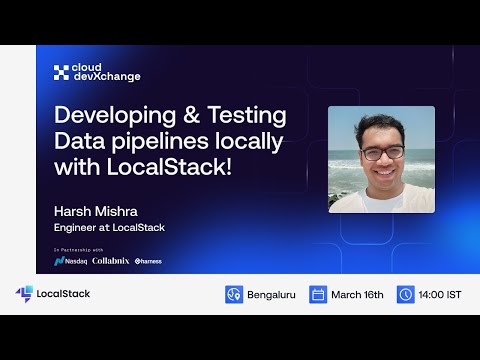
Creating data pipelines and applications for the cloud comes with challenges like a complicated developer experience, dealing with managed cloud dependencies, and enduring long build times. These issues often disrupt your development and testing cycles.LocalStack's cloud emulation allows you to construct, deploy, and test data pipelines on your local machine. It facilitates integration testing of cloud solutions both locally and in CI pipelines. This approach saves time and money, enhances developer velocity, and supports high-quality, agile, test-driven development.In this talk, Harsh delves into developing and testing cloud-based data pipelines on your local machine. The session will provide a firsthand look at the new Snowflake emulator and demonstrate how you can use LocalStack to create Snowflake warehouses, databases, schemas, and tables, and integrate frameworks like Snowpark.
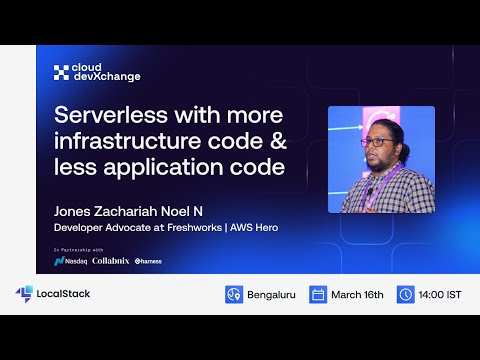
With the growing Serverless workloads, managing and maintaining them is best recommended with Infrastructure as Code (IaC). While this holds the complete infrastructure and its configurations, we could have events from one service destined to another via configuration. When building these configurations, we could also reduce the application code making it more maintainable and scalable.In this session, Jones walked us through a fully end-to-end solution built with Amazon EventBridge and AWS Step Functions with SDK integrations which have helped him to improvise the application with just IaC and very minimal application code.
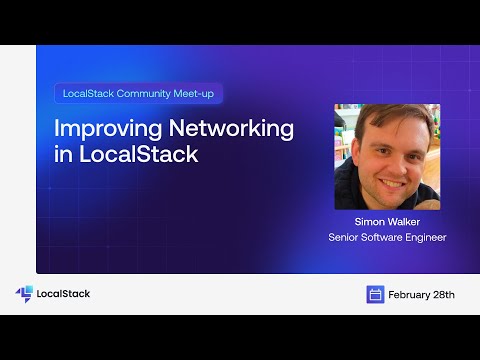
Connecting your applications to LocalStack has not always been easy. In this video, Simon from the LocalStack team discusses how we streamlined the LocalStack networking experience. We discussed the challenges of connecting your applications to LocalStack and how we're simplifying the LocalStack networking experience.Simon also discussed about configurations required for more complex networking setups, and some common networking scenarios, with example configuration for achieving connectivity.Read our blog to learn more: https://blog.localstack.cloud/2024-03-04-making-connecting-to-localstack-easier/
Launch yourself in the world of local cloud development
