
Upcoming Events
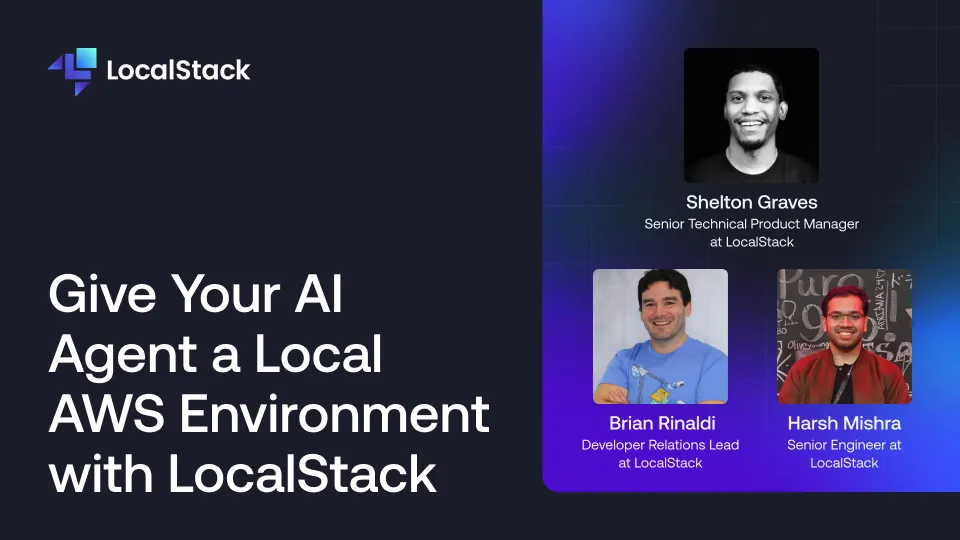
An agent will write you a CDK stack, a Terraform module, or a stack of IAM policies in seconds.
Whether any of it works is a separate question, and the usual way to find out is to deploy to a real AWS account and watch what breaks.
In an agentic workflow, that means giving AI access to a public cloud account, racking up costs on the AWS bill, and waiting for provisioning to complete every time you push new code to the environment.
Join this livestreamed demo on Thursday, June 25, to see how our users:
- Give AI agents a simulated AWS environment that runs locally so they can test for the cloud without access or costs
- Enable agents to deploy and validate code in the local environment
- Review failures, read logs, and validate fixes instantly directly via their agents
- Ship validated code to staging or production by simply swapping the endpoint for your AWS account
Have a talk idea?
Do you want to present at our events? We are not just limited to LocalStack—Talks around AWS, Developer Productivity, Cloud Security, DevOps toolings, Development & Testing loops, Snowflake and more would add great value to our members. Fill out the form to propose your talk at one of our Community Events
Previous Talks
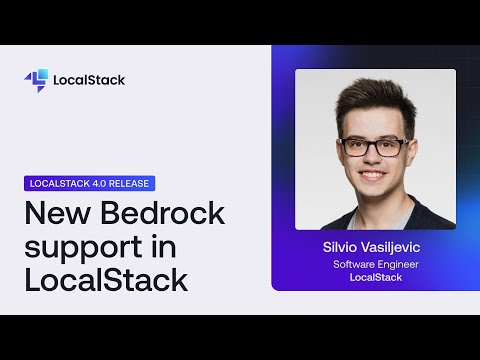
Bedrock is a fully managed service provided by Amazon Web Services (AWS) that makes foundation models from various LLM providers accessible via an API. LocalStack allows you to use the Bedrock APIs to test and develop AI-powered applications in your local environment.In this video, Silvio showcases how LocalStack 4.0, with our new Bedrock support, is keeping up with advancements in Generative AI (GenAI) and large language Model (LLM) ecosystems. You'll learn what Amazon Bedrock is, the benefits of Bedrock emulation, and a live demo of how it works.## Resources- Documentation: https://docs.localstack.cloud/user-guide/aws/bedrock/- Get access: https://www.localstack.cloud/contact
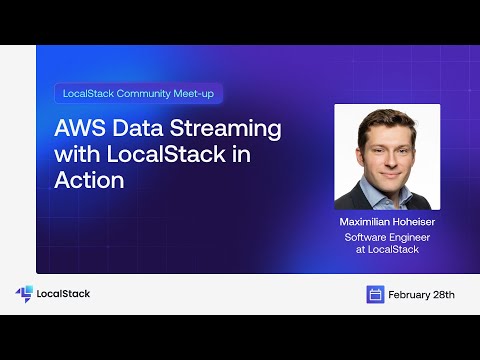
In this session, Maximillian Hoheiser discussed developing & testing AWS Data Streaming with LocalStack! In this talk, he focused on Kinesis Data Firehose, an AWS service that allows you to extract, transform, and load streaming data into various destinations like Amazon S3.He dived into how to set up testing for Kinesis Firehose and seamlessly integrated it with other services using Boto3 and CDK/CloudFormation. Maximillian led a live demonstration, showcasing how to set up a practical business case, implement it, and rigorously test it using LocalStack.
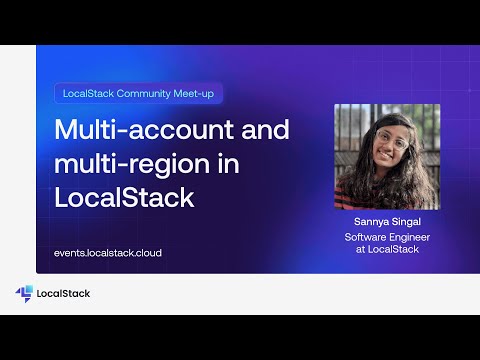
Multi-account and multi-region compatibility enables users to manage and deploy resources across multiple AWS accounts and geographic regions. This functionality enhances the robustness of the deployments by offering improved fault tolerance, scalability, and regulatory compliance. By segregating resources into separate accounts and distributing them across various regions, users can minimize the impact of potential failures and optimize performance.In this session from LocalStack Community Meetup May '24, Sannya Singhal discussed how you could use LocalStack to emulate multi-account and multi-region environments locally for testing and development purposes, ensuring that applications were resilient and scalable before deployment to the cloud.
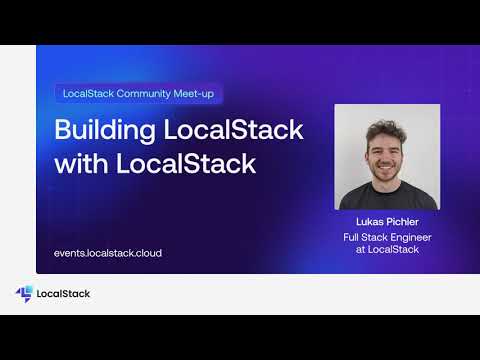
LocalStack’s core cloud emulator allows us to run our own cloud application - including its infrastructure - locally, which provides an efficient developer experience at the start of the entire software development lifecycle (SDLC). This experience enables us to build our product features in a way that closely matches what our customers are looking for — a comprehensive developer platform that facilitates local multi-cloud development across different providers and services.In this session from LocalStack Community Meetup April '24, Lukas Pichler showcases how to use the LocalStack core cloud emulator and other novel solutions, to build, test, and integrate new features in our LocalStack Web Application. He broadly discusses:• Application Overview• How do we enable local cloud development?How do we use LocalStack in CI?• How do we use LocalStack to enable application previews and E2E testing?• Conclusion
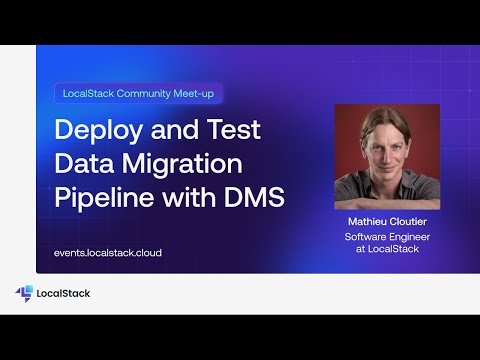
AWS Database Migration Service provides migration solutions from databases, data warehouses, and other types of data stores (e.g. S3, SAP). The migration can be homogeneous (source and target have the same type), but often is heterogeneous as it supports migration from various sources to various targets (self-hosted and AWS services).LocalStack supports DMS with selected use cases. In this session from LocalStack Community Meetup July '24, Mathieu Cloutier explores how to use LocalStack to migrate from a MariaDB database to an AWS Kinesis Stream. He goes over the differences between CDC and full load, and as a bonus you will see how easy it is to migrate from an external database to your Kinesis Stream — tested all on your local machine!Docs: https://docs.localstack.cloud/user-guide/aws/dms/
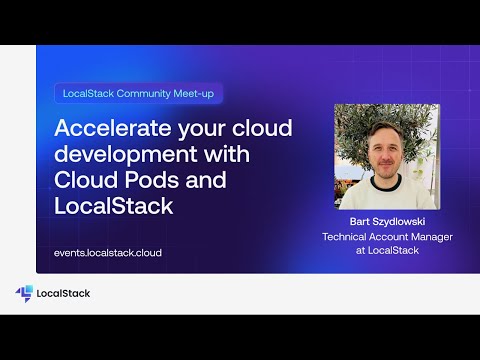
Cloud pods are persistent state snapshots of your LocalStack instance that can easily be stored, versioned, shared, and restored. Cloud Pods can be used for various purposes, such as:• Save and manage snapshots of active LocalStack instances.• Share state snapshots with your team to debug collectively.• Automate your testing pipelines by pre-seeding CI environments.• Create reproducible development and testing environments locally.In this session from LocalStack Community Meetup July '24, Bart Szydlowski explores how to use Cloud Pods to accelerate your cloud development & testing. He showcases how you can get started with Cloud Pods, integrate them into your testing pipelines, and make it easy for your team members to be onboarded to your cloud infrastructure — running all on your local machine!Docs: https://docs.localstack.cloud/user-guide/state-management/cloud-pods/
Launch yourself in the world of local cloud development
