Unified Kubernetes Support in LocalStack

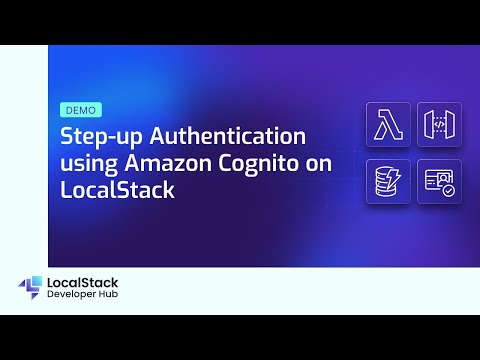
LocalStack now provides enhanced support for running AWS services in Kubernetes environments. In this presentation from the LocalStack 4.0 community meetup by Simon Walker, we explore how to deploy and manage local AWS resources within Kubernetes clusters with LocalStack, to help developers maintain consistency between development and production environments.The session further covers LocalStack’s Kubernetes integration, including deployment via Helm charts, configuration of services like Lambda and RDS as Kubernetes pods, and networking between components. A demo illustrates provisioning a serverless application (Lambda functions interacting with a MySQL database) using Terraform, with all resources managed within a local Kubernetes cluster.You'll additionally learn the practical approaches for local testing and infrastructure emulation by moving from Docker to Kubernetes-native solutions as well as upcoming features, including broader service support and new container runtime options.## Resources- Documentation: https://docs.localstack.cloud/user-guide/localstack-enterprise/kubernetes-executor/- Get access: https://www.localstack.cloud/contact

Related Talks
Handwritten digit recognition using MNIST model and Sagemaker on LocalStack

LocalStack Applications in Developer Hub provides sample templates to help LocalStack users adopt real-world scenarios to rapidly and conveniently create, configure, and deploy applications locally. ## Getting startedIn this demo, we will setup a Sagemaker on Localstack

Watch recording
Watch recording
Testing Terraform AWS Modules in Harness CI with LocalStack

LocalStack enables organizations to automate their application testing and integration process through DevOps practices, such as continuous integration (CI). LocalStack allows organizations to move away from complicated AWS testing and staging environments by enabling a key component of testing and delivering cloud-native applications.To further automate the process, we use Infrastructure-as-Code (IaC) frameworks like Terraform that allow you to create your resources declaratively and apply those resources. Testing your Terraform modules against the real AWS cloud can be time-consuming and costly and can make you run into the risk of dangling resources after an unsuccessful CI run. Using LocalStack to emulate a mock ephemeral AWS infrastructure on CI pipelines allows you to work on the same functionality the real AWS cloud provides while cutting down testing costs and deployment times.In this session, Jim Sheldon, Senior Developer Advocate at Harness, will demonstrate how to use LocalStack to test Terraform modules on Harness CI. Harness CI allows you to create software pipelines that will enable you to check out your code, build the software, run your tests, and validate every code change. We wind up the session with updates about the all-new LocalStack release!

Watch recording
Watch recording
Adopting Testcontainers for local development

Local development and testing are significant for engineers who wish to ship confidently onto production environments. Test-driven development (TDD) has been adopted as an essential practice to enforce that and ensure that every code change is validated locally and on CI. This is where we arrive at the Testcontainers libraries that support your tests, providing lightweight, ephemeral instances of common databases, message brokers, web browsers, or anything else that can run in a Docker container. With Testcontainers, available in different popular languages: Java, Go, .NET, JavaScript/Typescript, and Python, you can replicate the production environment on your local machine and test everything (including AWS APIs powered by LocalStack)! Testcontainers ensure that the data access layer, user interface, and application are tested well at each step. In this session, we have looked at Testcontainers and how to adopt them to develop our applications locally and run our integration tests while using LocalStack to provision cloud resources inside a Docker container before pushing your application to production! In the end, we have also discussed how LocalStack and the Java version of Testcontainers play nicely with each other and wind up with updates about the all-new LocalStack release!

Watch recording
Watch recording

Launch yourself in the world of local cloud development

Try for free
Try for free
Talk to Sales
Talk to Sales