

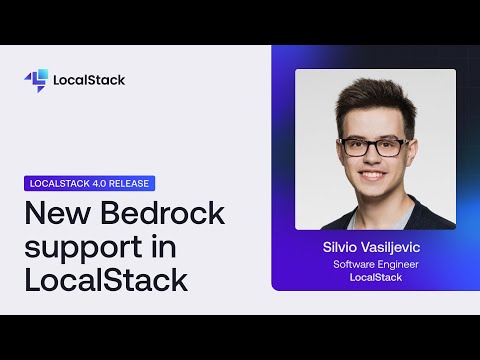
Bedrock is a fully managed service provided by Amazon Web Services (AWS) that makes foundation models from various LLM providers accessible via an API. LocalStack allows you to use the Bedrock APIs to test and develop AI-powered applications in your local environment. In this video, Silvio showcases how LocalStack 4.0, with our new Bedrock support, is keeping up with advancements in Generative AI (GenAI) and large language Model (LLM) ecosystems. You'll learn what Amazon Bedrock is, the benefits of Bedrock emulation, and a live demo of how it works.
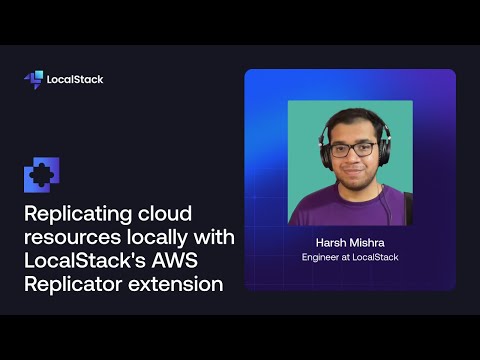
LocalStack's core cloud emulator lets you emulate various cloud services on your own computer. This means you can develop and test your cloud-based solutions without connecting to a remote cloud. However, there are times when you need to seamlessly switch between your local setup and actual cloud resources, especially in hybrid situations. For instance, you might want to share a database with your local Lambda function or access S3 files stored remotely while running a Glue ETL job locally. With LocalStack's AWS Replicator extension, your local environment can replicate AWS cloud resources at the API level, allowing direct interaction with cloud services. The Replicator extension enables you to forward specific requests from LocalStack to AWS without complex proxy setups, and create test scenarios that involve a mix of local and cloud resources.
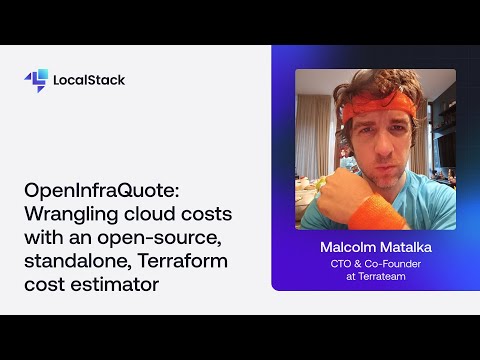
Cloud infrastructure has fueled innovation for nearly two decades—yet cost control remains a challenge. Unforeseen expenses and complicated billing can hamper agility, forcing teams to overspend just to stay competitive. What if you could evaluate costs in real-time, identify inefficiencies, and optimize deployments—without slowing development? Imagine adjusting parameters based on on-the-fly estimates and usage. In this presentation, Malcolm Matalka, Co-founder and CTO of Terrateam, explores how OpenInfraQuote, a new open-source command-line tool, transforms Terraform and OpenTofu code into actionable cost insights. Learn how to automate price checks, compare scenarios, and avoid financial surprises—alongside how it differs from other solutions and how to integrate it into your workflow.
