

LocalStack's Docker Extension allows developers to manage and run cloud applications locally within Docker Desktop efficiently. With a fully-integrated experience with features such as configuration profiles, container logs, and more, developers can now easily manage their LocalStack instance. In this video, Harsh from LocalStack discusses the LocalStack Docker Extension and how you can capitalize on an intuitive user experience to manage your LocalStack image, configuration profiles, and container logs directly within the Docker Desktop.
This is where it all comes together. CI/CD lets dev teams ship code automatically — but only if your pipeline is built to handle the cloud. In this episode, I show you how local testing + automated deployment = cloud apps that ship faster, safer, and smarter. Stick around to the end, this is the final episode of WTH is the Cloud?!
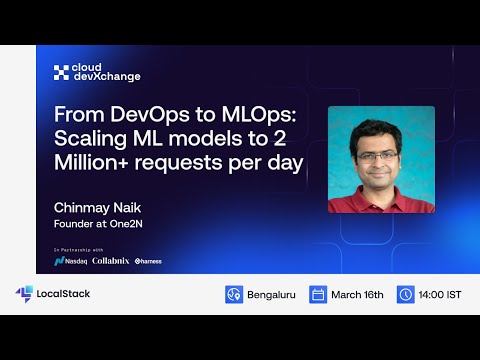
The challenge with Machine Learning (ML) models is productionizing. It requires data ingestion, data preparation, model training, model deployment, and monitoring. Adopting MLOps practices is similar to DevOps practices. In MLOps, the workload changes, but some core principles like automation, continuous integration/continuous deployment (CI/CD), and monitoring. Taking DevOps practices, I will discuss the similarities and differences in adopting MLOps practices. In this talk, Chinmay takes a production use case to scale ML models to 2 million+ daily requests. It leverages Google Cloud's (GCP) infrastructure to use its GPU and other services. This talk will help you draw similarities between DevOps and MLOps as a DevOps practitioner and help you learn how to run Machine Learning models at the production scale with best practices.
