Serverless Best Practices with AWS Lambda PowerTools

For one-off tasks, AWS Lambda really can be incredibly easy. You write a few lines of code, deploy it, and you have a function running in the cloud ready to respond to events, scale automatically, and that only costs you pennies. But as your application grows, so does some necessary complexity. When a few one-off functions become a full serverless backend architecture made up of interconnected services, you’ll need to pay careful attention to best practices to ensure that your application is easy to debug, maintain, and scale. That’s where AWS Powertools for Lambda fits in. It’s a suite of reusable utilities designed to simplify bringing best practices around things like logging, tracing, metrics, idempotency and more to your Lambda functions with minimal effort. This demo session will dive into some of the functionality provided by the AWS Powertools (TypeScript) core libraries, such as encapsulating best practices into reusable libraries for structured logging, metrics collection, idempotency, and more; leveraging Middy middleware to integrate common cross-cutting concerns, such as injecting Lambda context or automatically flushing metric; enabling local testing with LocalStack, allowing you to deploy and debug Lambda functions with structured logs, trace data, and embedded metrics; and providing modular examples that can be deployed to AWS or LocalStack with ease, enabling developers to explore libraries.

Related Talks

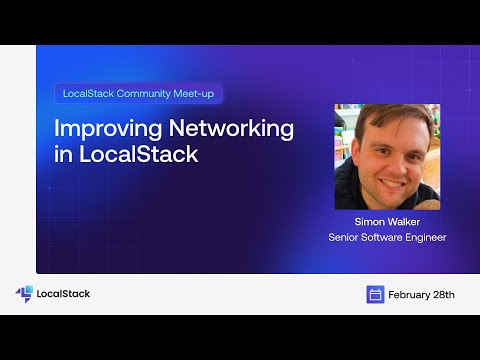
Improving Networking in LocalStack

Connecting your applications to LocalStack has not always been easy. In this video, Simon from the LocalStack team discusses how we streamlined the LocalStack networking experience. We discussed the challenges of connecting your applications to LocalStack and how we're simplifying the LocalStack networking experience. Simon also discussed about configurations required for more complex networking setups, and some common networking scenarios, with example configuration for achieving connectivity.
Learn More
Learn More
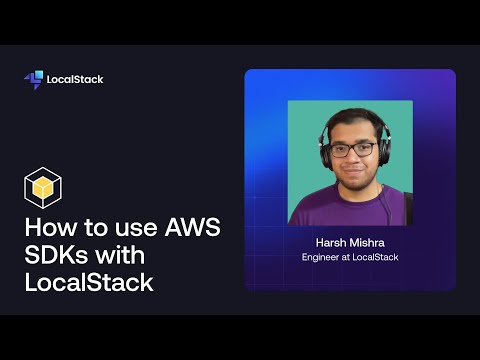
How to use AWS SDKs with LocalStack

LocalStack integrates with official AWS Software Development Kits (SDKs) so you can connect to LocalStack services using the same application code you use for AWS services. This lets you develop and test your applications locally without connecting to the cloud. In this video, we will talk about how you can connect to LocalStack emulated services using AWS SDKs.

Learn More
Learn More
How to save state in LocalStack?

LocalStack is ephemeral, so when you stop and restart it, all data is lost. You can use certain features to save the state & load it back when you restart LocalStack. This includes saving the local state for S3 buckets, DynamoDB tables, RDS databases and more. In this video, we explore three mechanisms that allow you to save state in LocalStack: persistence, state export and import, and Cloud Pods.

Learn More
Learn More

Launch yourself in the world of local cloud development

Try for free
Try for free
Talk to Sales
Talk to Sales