You've been there: Lambda triggers, SQS messages fly, Step Functions execute, and somewhere in the middle, something breaks. You have no idea what triggered what, what payload was passed, or where it all went wrong.
That's the black box problem of AWS development.
Once your architecture grows beyond a single service, visibility disappears fast. You're left stitching together scattered logs and redeploying just to see what's going on.
App Inspector is LocalStack's built-in observability layer that opens up that black box. It gives you a real-time, unified view of every service interaction happening inside your local cloud: what triggered what, with what payload, in what order.
In this talk, we'll walk through what App Inspector is, how it fits into your LocalStack workflow, and how to use it to catch bugs locally before they ever reach staging or production.

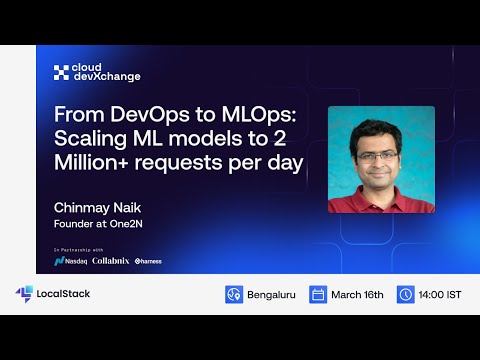
The challenge with Machine Learning (ML) models is productionizing. It requires data ingestion, data preparation, model training, model deployment, and monitoring.Adopting MLOps practices is similar to DevOps practices. In MLOps, the workload changes, but some core principles like automation, continuous integration/continuous deployment (CI/CD), and monitoring. Taking DevOps practices, I will discuss the similarities and differences in adopting MLOps practices.In this talk, Chinmay takes a production use case to scale ML models to 2 million+ daily requests. It leverages Google Cloud's (GCP) infrastructure to use its GPU and other services. This talk will help you draw similarities between DevOps and MLOps as a DevOps practitioner and help you learn how to run Machine Learning models at the production scale with best practices.

Testing AWS CI/CD pipelines in the cloud can be slow, error-prone, and hard to debug, especially when you're wrestling with IAM permissions or waiting on long feedback cycles. This session walks through how you can now emulate complete DevOps workflows locally using LocalStack.We cover recent additions to LocalStack that support new service providers such as: CodeBuild: Run build processes across different runtimes directly on your machine CodeDeploy: Emulate deployment steps without touching the real infrastructure CodePipeline: Create and test CI pipelines, transitions, and triggers locallyThrough a live demo, we’ll walk through a working example of a CI/CD pipeline — building a Rust project, deploying it, and running the pipeline stages — all without leaving your laptop.This session is useful for developers building or debugging AWS-native CI/CD workflows and looking for faster, more controlled ways to test them.

Creating data pipelines and applications for the cloud comes with challenges like a complicated developer experience, dealing with managed cloud dependencies, and enduring long build times. These issues often disrupt your development and testing cycles.LocalStack's cloud emulation allows you to construct, deploy, and test data pipelines on your local machine. It facilitates integration testing of cloud solutions both locally and in CI pipelines. This approach saves time and money, enhances developer velocity, and supports high-quality, agile, test-driven development.In this talk, Harsh delves into developing and testing cloud-based data pipelines on your local machine. The session will provide a firsthand look at the new Snowflake emulator and demonstrate how you can use LocalStack to create Snowflake warehouses, databases, schemas, and tables, and integrate frameworks like Snowpark.