


What happens when your cloud services fail? 💥 In this final episode of our series, we dive into the LocalStack Chaos Dashboard to simulate real-world outages—like DynamoDB errors—and see how your app responds under pressure. Learn how to intentionally break your systems locally so you can ship more resilient applications in production.
Bring your tests to CI/CD with GitHub Actions! In this episode, we’ll show how to integrate LocalStack into your workflow, so your tests run automatically on every push without touching real AWS resources. Whether you're testing Lambda, DynamoDB, S3, or beyond LocalStack makes it possible to run everything locally, even in your CI workflows.
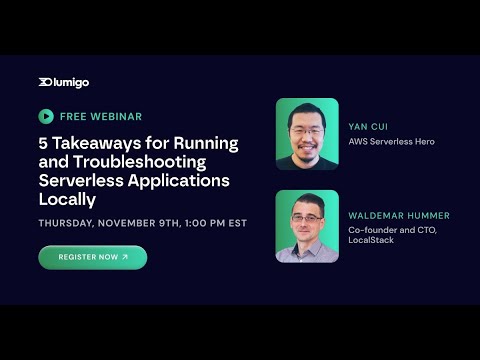
Check out the recording of the hands-on webinar featuring Yan Cui, AWS Serverless Hero, and Waldemar Hummer, CTO of LocalStack, to learn practical use cases around monitoring serverless applications for local dev&test loops. Learn the best practices for debugging serverless applications using various AWS services to support your serverless workflows while troubleshooting errors and performance issues. In this video, you will learn about building and deploying Serverless apps locally, common patterns and workflows for testing Serverless apps, troubleshooting errors and performance issues in dev&test loops, implementing observability with distributed tracing with Lumigo, and local Serverless development with LocalStack.
