

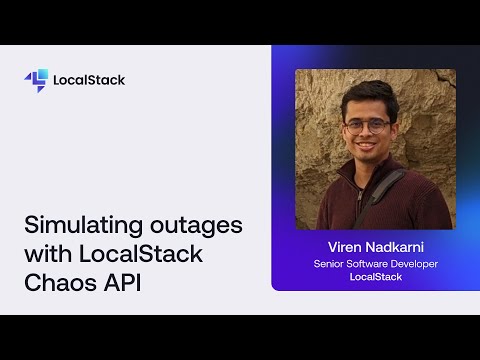
LocalStack Chaos API enables you to simulate outages in any AWS region or service. Chaos API provides an easy way to implement chaos engineering experiments to test a wide variety of simulated outages and failures within your application safely, without impacting your production users. Common examples can include region-wide outages, DNS failovers, service failures, and network faults. All the testing scenarios described above can be executed within LocalStack, providing thorough coverage for critical situations in a matter of minutes rather than hours or days. In this presentation by Viren Nadkarni, we explore how Chaos API is leveraged to perform service failures in a local environment while using robust error handling to address and mitigate such issues.
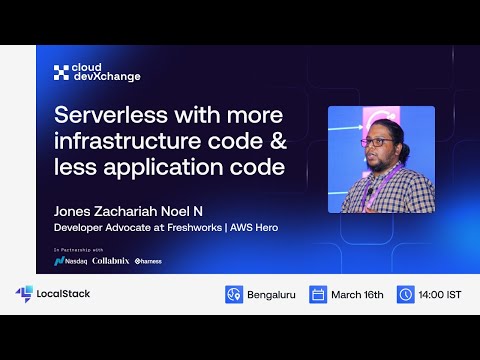
With the growing Serverless workloads, managing and maintaining them is best recommended with Infrastructure as Code (IaC). While this holds the complete infrastructure and its configurations, we could have events from one service destined to another via configuration. When building these configurations, we could also reduce the application code making it more maintainable and scalable. In this session, Jones walked us through a fully end-to-end solution built with Amazon EventBridge and AWS Step Functions with SDK integrations which have helped him to improvise the application with just IaC and very minimal application code.

Tired of rebuilding your stack from scratch every time you run tests or restart your dev environment? In this episode, we dive into Cloud Pods, LocalStack’s powerful state management feature. You’ll learn how to snapshot your entire LocalStack environment (services, resources, data), restore that exact state across machines, teams, or CI runs, speed up test cycles and workflows, and use Cloud Pods to make testing in CI/CD faster and more reliable. Cloud Pods let you freeze your infrastructure in time. Perfect for repeatable tests, isolated dev environments, or onboarding new teammates.
