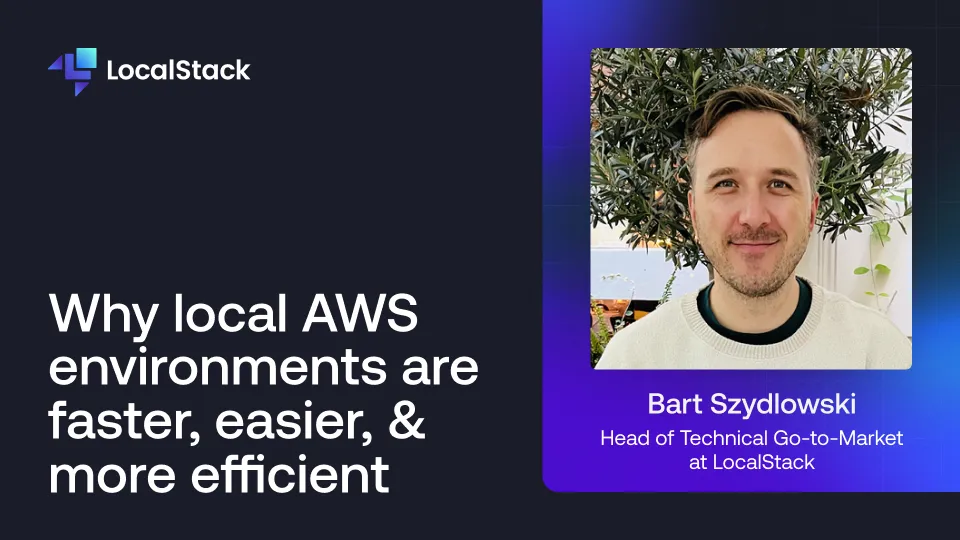
Accelerate your cloud development with Cloud Pods and LocalStack

Cloud pods are persistent state snapshots of your LocalStack instance that can easily be stored, versioned, shared, and restored. Cloud Pods can be used for various purposes, such as:• Save and manage snapshots of active LocalStack instances.• Share state snapshots with your team to debug collectively.• Automate your testing pipelines by pre-seeding CI environments.• Create reproducible development and testing environments locally.In this session from LocalStack Community Meetup July '24, Bart Szydlowski explores how to use Cloud Pods to accelerate your cloud development & testing. He showcases how you can get started with Cloud Pods, integrate them into your testing pipelines, and make it easy for your team members to be onboarded to your cloud infrastructure — running all on your local machine!Docs: https://docs.localstack.cloud/user-guide/state-management/cloud-pods/

Related Talks

Introducing lstk: The New LocalStack CLI

Silvio and Carole introduce lstk, LocalStack's next-generation CLI built from scratch in Go. They explain why the team rebuilt the CLI, walk through its key features — zero-config startup, seamless browser-based authentication, and a rich interactive TUI that surfaces real-time progress and actionable errors — and demo how lstk gets you from install to a running emulator in seconds. They also dive into the architecture behind lstk and how it is designed to support multiple emulators, flexible runtimes, and deep integrations with CI pipelines and IDEs.
Learn More
Learn More
Simulate Microservices, Cloud Services, and Everything Else with WireMock

Cloud-first development kills your inner dev loop. There's a better way.TypeDB on AWS is powerful — Lambda functions querying complex relationship hierarchies, recursive schema functions resolving transitive memberships, all without application logic. But iterating on schemas and queries in the cloud is slow and expensive.Harsh Mishra introduces the TypeDB extension for LocalStack: run a fully functional TypeDB server inside your local AWS environment and connect your app exactly as you would in production. Faster iteration, zero unnecessary spend.

Learn More
Learn More
Why Property Graphs Aren't Enough

Are Property Graphs living up to the hype? Maybe the model itself is the problem.We made the move from relational databases to graph databases to escape "Join Pain" and model the real world more naturally — but for many engineering teams, that promise has curdled into something worse: the Spaghetti Graph.Complex queries. Ugly workarounds for multi-party relationships. Fragile schemas that shatter with every iteration and become a nightmare to maintain.The good news? The problem isn't your data.In this talk, Joshua Send breaks down why standard Labeled Property Graphs (LPGs) fall short when applied to complex domains — and introduces TypeDB, a strongly-typed database that brings together the connectivity of a graph with the integrity of a relational model.You'll come away understanding:Why LPGs struggle at scale and complexityWhat "Spaghetti Graphs" are and how teams fall into the trapHow TypeDB's type system enforces data integrity without sacrificing flexibilityWhen a strongly-typed graph database is the right tool for the jobWhether you're deep in a graph migration, evaluating database architectures, or just tired of schema chaos — this one's for you.

Learn More
Learn More

Launch yourself in the world of local cloud development

Try for free
Try for free
Talk to Sales
Talk to Sales