
Upcoming Events
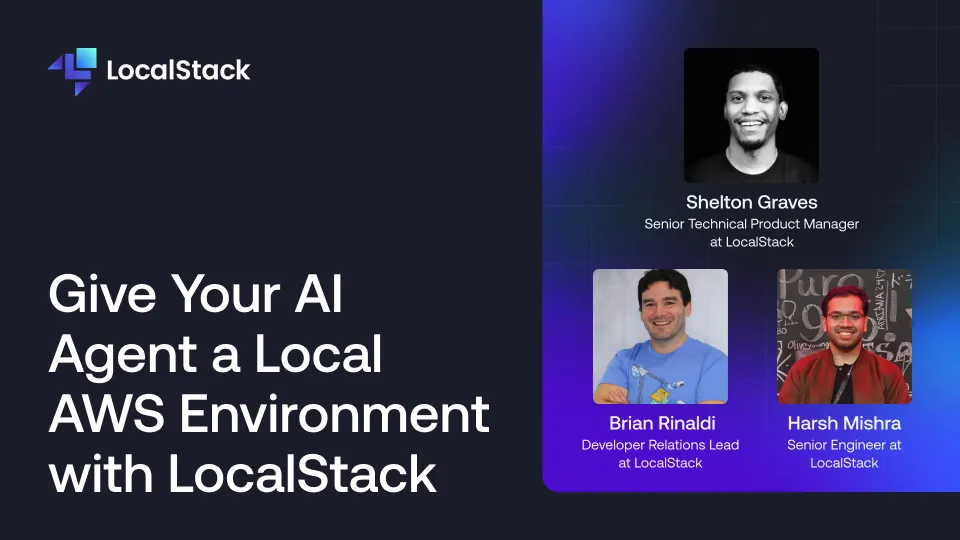
An agent will write you a CDK stack, a Terraform module, or a stack of IAM policies in seconds.
Whether any of it works is a separate question, and the usual way to find out is to deploy to a real AWS account and watch what breaks.
In an agentic workflow, that means giving AI access to a public cloud account, racking up costs on the AWS bill, and waiting for provisioning to complete every time you push new code to the environment.
Join this livestreamed demo on Thursday, June 25, to see how our users:
- Give AI agents a simulated AWS environment that runs locally so they can test for the cloud without access or costs
- Enable agents to deploy and validate code in the local environment
- Review failures, read logs, and validate fixes instantly directly via their agents
- Ship validated code to staging or production by simply swapping the endpoint for your AWS account
Have a talk idea?
Do you want to present at our events? We are not just limited to LocalStack—Talks around AWS, Developer Productivity, Cloud Security, DevOps toolings, Development & Testing loops, Snowflake and more would add great value to our members. Fill out the form to propose your talk at one of our Community Events
Previous Talks
Looking to bring AWS emulation directly into your CI/CD pipelines? This hands-on session with Harsh Mishra shows you how to integrate LocalStack with Dagger to level up your development workflows.In this session, you'll learn how to:- Run full AWS emulation locally inside Dagger pipelines- Spin up LocalStack as a service using Dagger’s composable syntax- Use Cloud Pods for persistent state across pipeline runs- Create ephemeral environments for fast, clean, isolated testingKeep your cloud workflows repeatable, testable, and fastWhether you’re building serverless apps, managing infrastructure-as-code, or optimizing your DevOps pipelines, this talk will help you bring LocalStack into the heart of your CI/CD setup.
Want to modernize your CI/CD workflows? 🚀 In this session, Jason McCallister introduces Dagger, the open-source programmable CI/CD engine that’s redefining how we build, test, and ship software.You'll learn:- What makes Dagger different from traditional CI/CD tools- How to write pipelines as code and run them locally- How to compose reusable, testable pipeline components- Real-world examples of solving CI headaches with Dagger- Integration tips with Docker, Kubernetes, and beyondWhether you’re a DevOps pro, platform engineer, or just tired of brittle YAML, this talk will show you how Dagger helps you ship faster and smarter.
Testing AWS CI/CD pipelines in the cloud can be slow, error-prone, and hard to debug, especially when you're wrestling with IAM permissions or waiting on long feedback cycles. This session walks through how you can now emulate complete DevOps workflows locally using LocalStack.We cover recent additions to LocalStack that support new service providers such as: CodeBuild: Run build processes across different runtimes directly on your machine CodeDeploy: Emulate deployment steps without touching the real infrastructure CodePipeline: Create and test CI pipelines, transitions, and triggers locallyThrough a live demo, we’ll walk through a working example of a CI/CD pipeline — building a Rust project, deploying it, and running the pipeline stages — all without leaving your laptop.This session is useful for developers building or debugging AWS-native CI/CD workflows and looking for faster, more controlled ways to test them.
dbt (Data Build Tool) helps data engineers manage data transformations using modular SQL and brings version control, testing, and documentation to their transformation logic. However, running dbt against production data warehouses like Snowflake can be slow, expensive, and risky.This session introduces a new way to develop and test dbt workflows locally using the Snowflake emulator in LocalStack. You'll learn how to: Set up a local dbt environment Configure dbt to connect to the Snowflake emulator Run and validate dbt models locally without using a real Snowflake account Iterate quickly on transformations before pushing them to productionThrough a hands-on factory app example, we’ll walk through how to use the Snowflake emulator to run dbt models on your laptop, helping you test logic, catch issues early, and reduce cloud costs.
Running AI/ML workloads in the cloud can be expensive, opaque, and difficult to iterate on. LocalStack changes this by enabling engineers to develop and test AI-powered cloud applications entirely locally, emulating services like SageMaker, Bedrock, Redshift, and Snowflake.In this presentation, Waldemar Hummer, CTO of LocalStack, demonstrates how to prototype and validate AI & ML data pipelines safely and cost-effectively using LocalStack’s cloud emulators. You’ll see how to emulate complex AI workflows, test integrations, and use “vibe coding” techniques confidently in a fully sandboxed local environment.
Cloud infrastructure has fueled innovation for nearly two decades—yet cost control remains a challenge. Unforeseen expenses and complicated billing can hamper agility, forcing teams to overspend just to stay competitive.What if you could evaluate costs in real-time, identify inefficiencies, and optimize deployments—without slowing development? Imagine adjusting parameters based on on-the-fly estimates and usage.In this presentation, Malcolm Matalka, Co-founder and CTO of Terrateam, explores how OpenInfraQuote, a new open-source command-line tool, transforms Terraform and OpenTofu code into actionable cost insights. Learn how to automate price checks, compare scenarios, and avoid financial surprises—alongside how it differs from other solutions and how to integrate it into your workflow.Resources- GitHub: https://github.com/terrateamio/openinfraquote- Documentation: https://openinfraquote.readthedocs.io/en/latest/
Launch yourself in the world of local cloud development
